Author
Prem Chandran
Over the past two years, organizations have moved quickly from experimentation to deployment. Tools like Microsoft 365 Copilot only reached enterprise availability in late 2023, and for many, 2024 marked the first real push into production.
That makes 2026 the first year where enough organizations have been running AI at long enough to measure what’s working and what isn’t.
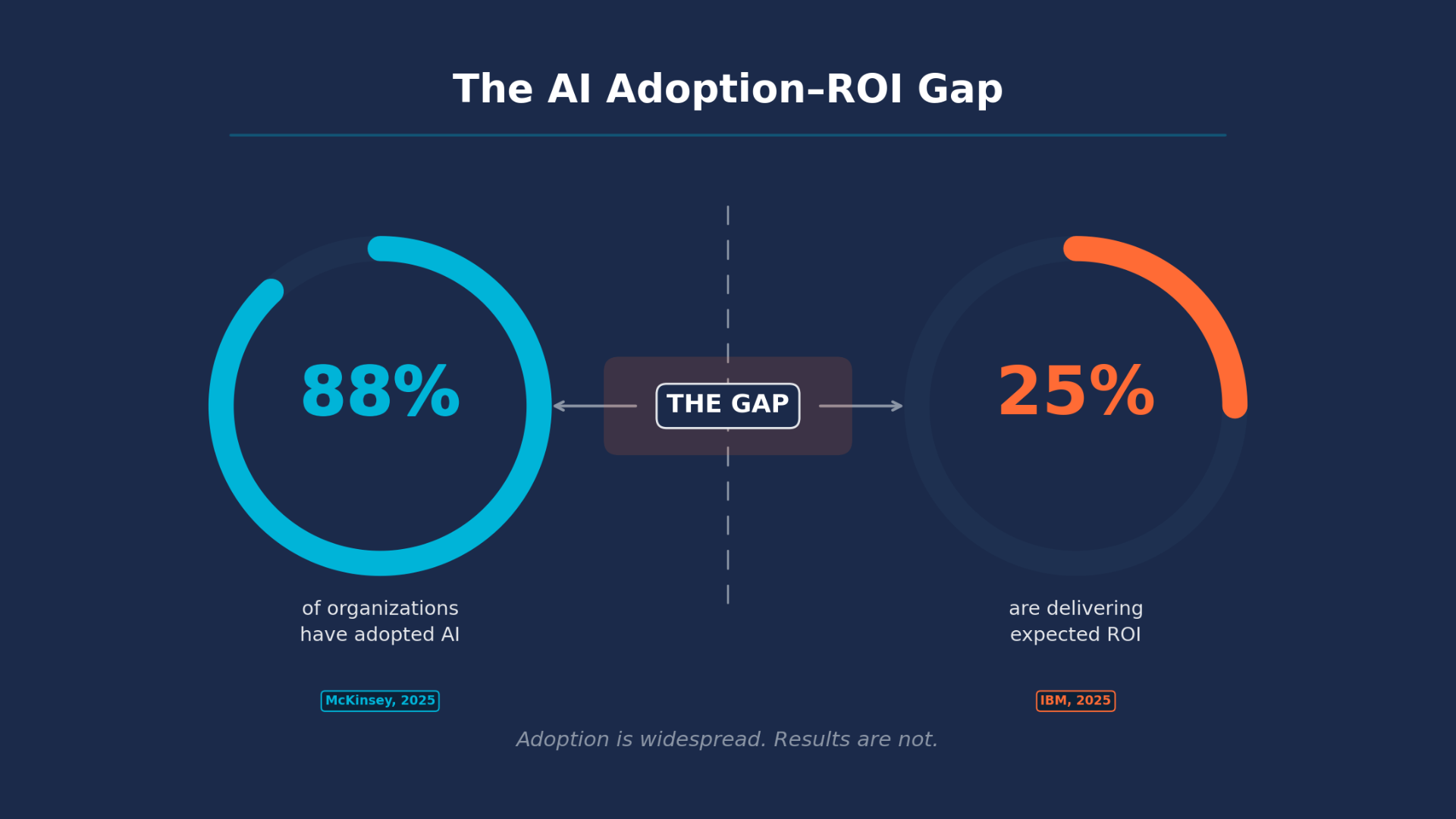
While AI adoption has surged, reaching nearly 90% of organizations, only a fraction are seeing meaningful returns. Studies suggest that as few as 25% of AI initiatives are delivering expected ROI, with even fewer scaling across the enterprise.
Here’s what the data says and what it means for your organization.
Adoption Is Widespread but Results Are Not
AI has moved firmly into the mainstream, with generative AI now embedded in at least one business function in most organizations. But adoption hasn’t translated into consistent outcomes.
A relatively small group of companies is pulling ahead, capturing a disproportionate share of the value. According to recent research, nearly three-quarters of AI’s economic impact is being realized by just 20% of organizations.
For everyone else, the experience is less clear. Many teams report productivity gains, yet fewer than half are seeing measurable impact at the enterprise level.
The Real Challenge Isn’t Technology
One of the most common misconceptions about AI ROI is that it’s a technology problem. The biggest barriers are operational.
Research consistently shows that while nearly 80% of organizations report productivity improvements from AI, only a small percentage can confidently measure its financial impact. The gap isn’t in capability, it’s in execution.
Most organizations haven’t redesigned workflows, aligned their data, or built the internal structure needed to support AI at scale.
Where AI Is Delivering Real Value
When AI is implemented effectively, the impact is measurable. For example, organizations using tools like Microsoft 365 Copilot are reporting time savings of up to 9 hours per user per month, alongside faster onboarding and improved task completion speeds. But these results aren’t universal.
They tend to show up in organizations that have invested beyond the tool itself, focusing on readiness, governance, and how AI fits into day-to-day work.
What High-Performing Organizations Do Differently
The organizations seeing meaningful returns from AI aren’t simply using it more. They’re approaching it with a fundamentally different level of focus and discipline.
They don’t treat AI as a standalone capability. Instead, they integrate it into how the business operates, tying it directly to outcomes, workflows, and decision-making.
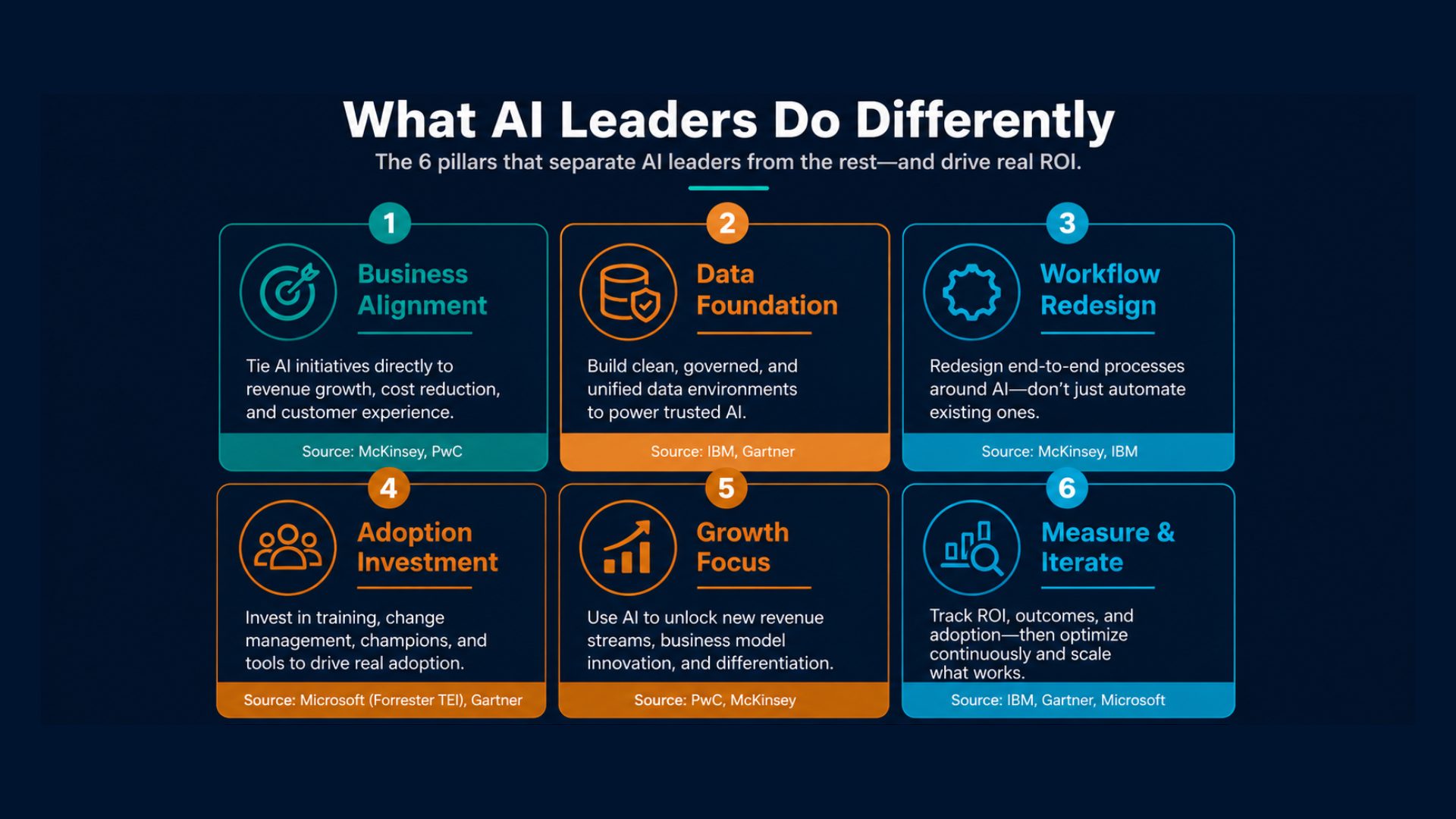
Across every major study, the same patterns show up consistently. High-performing organizations tend to:
- Start with business alignment and not just the tools. They prioritize a small number of high-impact use cases tied to real business outcomes. Organizations that scale AI across multiple use cases see significantly higher returns than those running isolated pilots.
- Build a strong data foundation early. Clean, governed, and accessible data is a prerequisite. Without it, AI outputs are inconsistent and difficult to trust, slowing adoption and limiting value.
- Redesign workflows instead of layering AI on top. This is one of the clearest differentiators. Rather than accelerating existing processes, leading organizations rethink how work gets done altogether.
- Invest in adoption as much as deployment. Assigning licenses doesn’t drive value. Adoption requires enablement, governance, and clear guidance on how AI fits into day-to-day work.
- Focus on growth and not just efficiency. While many organizations start with productivity gains, leaders quickly expand their focus to revenue, innovation, and new ways of delivering value.
- Measure impact and iterate continuously. Instead of tracking usage alone, they connect AI initiatives to outcomes such as; time saved, business performance, and financial impact, then refine as they scale.
Taken together, these aren’t isolated tactics, they reflect a more intentional approach to AI. And this is what ultimately separates organizations experimenting with AI from those actually benefiting from it.
So, Is AI Worth the Money?
Yes, but only with the right strategy. The data from all five firms converges on the same conclusion: AI delivers real, measurable ROI when organizations invest in readiness, governance, workflow redesign, and adoption alongside the technology itself. Without that foundation, even the most powerful AI tools become expensive shelf ware.
The gap between AI leaders and laggards is widening. PwC reports that 74% of AI’s economic gains are captured by just 20% of companies. McKinsey warns that two-thirds are stuck in pilot mode. IBM confirms only 25% of initiatives deliver expected returns.
The opportunity is enormous. The question is whether your organization is ready to capture it.
Where to Go From Here
At this stage, the most important thing isn’t speed, it’s direction.
Organizations that step back and assess where they are today tend to move faster in the long run. Understanding where AI can create real impact and what needs to change to support it. This is what separates progress from stagnation.
That’s typically where structured support becomes valuable. Not to introduce more tools, but to bring clarity and aligning use cases to business goals, preparing the environment, and ensuring adoption is set up to succeed from the start.
At Creospark, this is where we focus. We help organizations move from experimentation to measurable outcomes by connecting strategy, technology, and adoption into a single, practical path forward. If you’re trying to understand what AI should look like in your organization and not just what it can do then that’s the right place to start.
 Book a Copilot Readiness Assessment to get a clear view of where you stand and what comes next.
Frequently Asked Questions
Q: What is the average ROI of AI in 2026?
A: IBM reports that only 25% of AI initiatives deliver expected ROI, and the average return sits at approximately 1.7×. However, Microsoft 365 Copilot specifically delivers up to 353% ROI over three years for SMBs, and top performers see significantly higher returns.
Q: How much time does Microsoft Copilot save?
A: Forrester’s TEI study found Copilot saves an average of 9 hours per user per month, with 50% faster completion of repetitive tasks and 25% faster new-hire onboarding.
Q: Why do AI projects fail?
A: Gartner found that only 28% of AI projects fully meet ROI expectations. The main barriers per IBM, McKinsey, and Gartner are poor data governance, lack of workflow redesign, skills gaps, and inadequate change management.
Q: What separates AI leaders from laggards?
A: According to PwC, leaders are 2–3× more likely to use AI for growth (not just efficiency), 2× more likely to redesign workflows, and they capture 74% of AI’s total economic value. McKinsey adds that high performers invest 20%+ of digital budgets in AI with strong senior leadership engagement.