Author
Prem Chandran
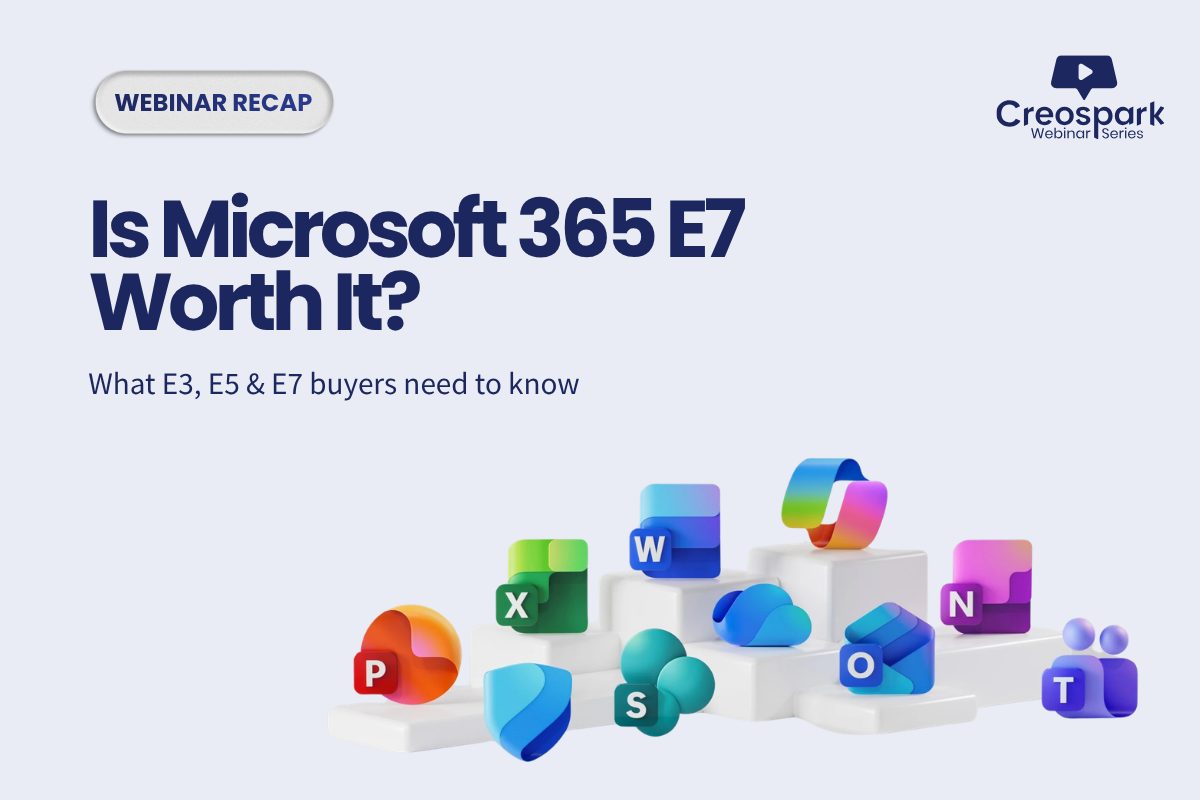
Microsoft 365 licensing has changed and this time, it’s not just a pricing update.
In our recent webinar, we explored a question that’s now landing on the desks of IT leaders, security teams, finance, and procurement simultaneously: Is Microsoft 365 E7 actually worth it?
This wasn’t a feature-by-feature comparison or a sales pitch for a higher SKU. Instead, the session focused on when E7 becomes the rational choice and when it doesn’t based on how Copilot is reshaping the way organizations think about licensing, identity, and risk.
Why Licensing Has Become Strategic Again
For nearly a decade, Microsoft enterprise licensing followed a predictable rhythm. Incremental upgrades. Stable cost models.
Copilot changes that entirely. It doesn’t just increase usage, it increases authority. It drafts, summarizes, recommends, and acts across email, documents, meetings, chat, and search, using the same permissions as the user, but at far greater speed and scale.
A single over-permissioned user is no longer a localized risk. Copilot can surface, combine, and redistribute that access instantly. Traditional licensing models were never designed for that kind of amplification.
Licensing is no longer about entitlement parity. It’s about whether your licensing posture aligns with the assumptions Copilot makes about trust, access, and governance.
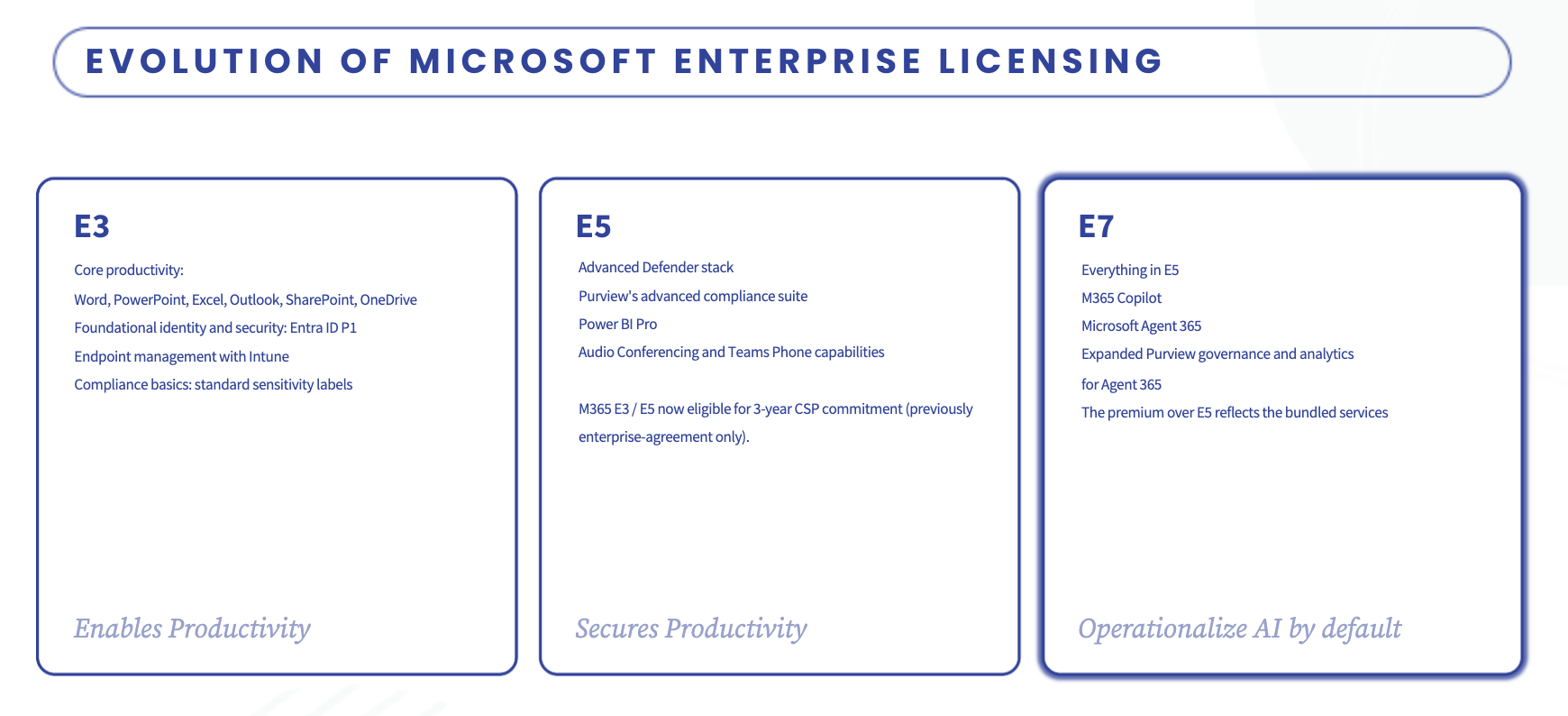
E3, E5, and E7 Are Not Tiers, They’re Operating Models
E3 assumed a straightforward model: users create, collaborate, and communicate. Risk was implicit and tolerated.
E5 emerged when security, compliance, and regulatory pressure became unavoidable. It didn’t change how work was done — it changed how work was controlled.
E7 assumes AI is now an active participant in work. Copilot synthesizes, recommends, drafts, and acts. When AI participates directly, identity and security stop being supporting functions — they become foundational.
Microsoft is no longer licensing tools. It is licensing an operating posture for AI-first work.
What E7 Actually Is And Why It Matters
Microsoft 365 E7 is not an arbitrary bundle. It’s Microsoft making a clear architectural statement about how AI should function inside a modern enterprise:
- E5 provides the security, compliance, and audit baseline
- Copilot introduces an AI system operating continuously with user-level authority
- Entra Suite provides the identity control plane
When licensed separately, organizations introduce sequencing risk — Copilot adoption moves faster than identity maturity, and security teams compensate with manual exceptions. Over time, risk is absorbed operationally rather than architecturally.
This is compounded by governance debt. Copilot pilots succeed quickly, demand spreads, but governance mechanisms aren’t ready for scale. Exceptions become policy. Manual reviews replace systemic controls.
E7 removes that sequencing problem. Without identity-led enforcement, AI simply amplifies mistakes. With it, AI becomes governable at enterprise scale.
Where E3 and E5 Fall Short
E3 environments pay the true cost not in license price, but in the operational tax of time, risk acceptance, and constant human oversight. It works for narrow pilots — it fails quickly at scale.
E5 significantly improves posture, but Copilot introduces seams. The operating model fragments. Planning becomes reactive. Decisions are made piecemeal.
E7 resolves this by removing decision points entirely. It assumes AI scale, identity maturity, and security depth by default — trading flexibility for predictability. For organizations scaling Copilot broadly, that predictability is often more valuable than incremental optimization.
The Real Cost Conversation
Most organizations begin this analysis with list-price math: E5 plus Copilot plus identity and security add-ons versus the E7 bundle. That arithmetic is directionally useful, but it is not the real decision.
The real cost issue with Copilot is cost predictability at scale.
Copilot adoption does not expand evenly. Some teams adopt aggressively. Others lag. Modular licensing creates variability that finance teams struggle to forecast and procurement teams struggle to manage mid-term. As adoption grows, identity and security investments are often pulled forward reactively — controls added because risk appears, not because they were planned.
E7 replaces that variability with a fixed operating assumption. You’re not buying cheaper licenses. You’re buying fewer surprises, fewer mid-term adjustments, and fewer emergency investments driven by audit findings or security pressure.
Timing compounds this further. An organization evaluating E7 six to twelve months before renewal has leverage and flexibility. An organization forced into the conversation mid-term often has fewer options. Context, risk posture, and timing matter more than arithmetic.
Signals You’re Approaching an E7 Moment
E7 is rarely a sudden leap. There are consistent signals:
- Copilot demand expanding beyond the original pilot
- Identity reviews and security audits surfacing uncomfortable findings
- Governance shifting toward exceptions and manual approvals
- Licensing becoming fragmented across groups
None of these indicate failure. They indicate success outpacing governance. When they appear together, E7 becomes a practical conversation — not because it’s fashionable, but because the existing licensing posture no longer matches reality.
When E7 Is Not the Right Move
E7 is not a default answer. It may be premature when:
- Copilot value is still unproven
- Usage is limited to narrow roles or experiments
- Renewal timing limits contractual flexibility
Licensing decisions should follow intent — not pressure. E7 works best when leadership has aligned on a core premise: AI is no longer experimental. It is foundational. Executive alignment is often the hardest part of the process — and the most valuable.
A Simple Framework for Better Decisions
The session outlined a practical three-part framework:
- Adoption trajectory — How quickly will Copilot expand and how broadly will it be used
- Identity maturity — Can access controls and governance scale with AI usage?
- Contract timing — Do you have leverage during renewal?
When all three align, E7 is often the cleanest path. When one lags, sequencing matters more than enthusiasm.
The Bottom Line
Microsoft’s direction is clear. Copilot is becoming the default productivity layer. Identity is becoming the control plane. Licensing is moving away from modular assembly toward standardized assumptions.
For organizations expanding Copilot beyond pilots, E7 increasingly becomes the least risky and most operationally coherent choice. It’s not about buying more technology — it’s about aligning licensing with how AI actually operates. For many organizations, E7 is not the cheapest option. It is the cleanest — and increasingly, the one that reduces risk rather than shifting it into people, process, and exceptions.
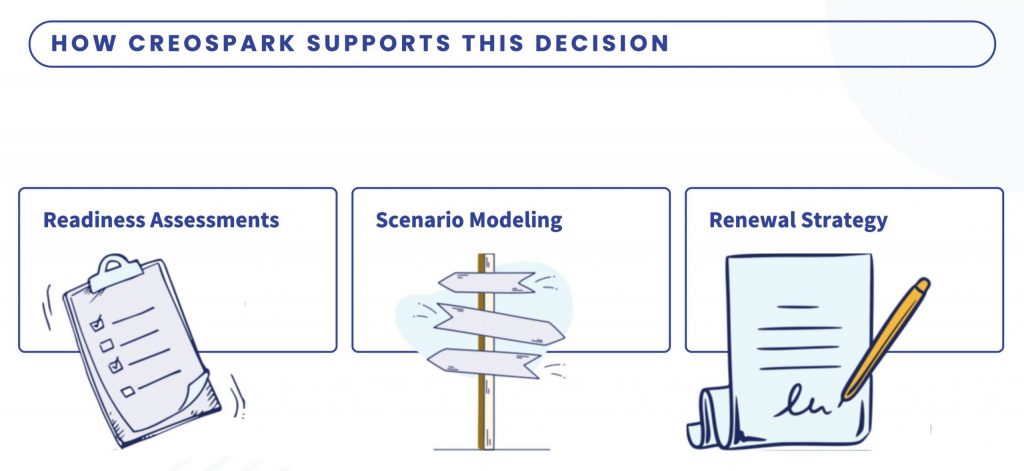
At Creospark, we help organizations make this decision deliberately — assessing readiness, modelling scenarios, and aligning renewal strategy so decisions are intentional, not reactive.
Thoughtful alignment beats reactive licensing every time.
Common Questions Answered
Who should get E7 vs. E5 + M365 Copilot vs. E5 + M365 Copilot + M365 Agents?
The right approach depends on your organization’s specific goals, current environment, and planned adoption of Copilot. We typically assess factors like scale, identity maturity, and governance requirements to recommend the most appropriate path. While the evaluation process is straightforward, the right outcome is always tailored to each organization.
How does E7 prevent AI hallucinations from affecting work?
E7 itself is a licensing model so it does not directly address hallucinations. However, a properly configured AI environment, including strong identity controls, access governance, and data quality practices, can significantly reduce risk. Our team works with organizations to design and implement these safeguards effectively. Book a consultation and see how we can help.
Are you able to work on an existing project?
Absolutely.
Resources and Next Steps
Missed the webinar?