Author
Prem Chandran
Most organizations we work with have already purchased Microsoft 365 Copilot licenses. Many have even completed a pilot. But six months in, the question we hear most often is the same one: why aren't more people using it? The answer is rarely a technology problem. It's an adoption problem — and adoption problems don't get solved by sending another reminder email or adding Copilot to an all-hands slide. They get solved by building the operating model that should have come first.
Most executives we speak with aren't questioning Copilot's potential. They're questioning why adoption hasn't moved faster — and what it will actually take to get there. This post answers that directly. It lays out a practical operating model for scaling Microsoft 365 Copilot across the enterprise: who needs to own it, where to focus first, how to enable people in phases, and how to measure whether it's working.
An effective operating model for Copilot at scale should answer four practical questions: who owns the program, where Copilot should be used first, how adoption will be enabled, and how security and value will be measured over time. Microsoft's guidance provides a strong foundation for planning and responsible AI adoption, but the real opportunity is to translate that guidance into a business-led adoption structure that fits how your organization actually works. For Copilot, success depends on connecting executive sponsorship, IT readiness, business enablement, governance, and measurable outcomes into one repeatable model.
1. Who Owns the Program?
A scalable Copilot operating model begins with clear ownership. Without a defined structure, Copilot adoption can quickly become fragmented across departments, with different teams experimenting independently and no consistent way to govern, enable, or measure success.
The strongest approach is to establish an AI Center of Excellence, or Copilot Center of Excellence, with visible executive sponsorship. This group becomes the central engine for adoption. It sets the vision, prioritizes use cases, defines governance guardrails, coordinates training, and ensures Copilot is embedded into real workflows.
A practical Copilot Center of Excellence should include:
- Executive sponsor: Communicates why Copilot matters and keeps the program aligned to business priorities.
- IT lead: Manages technical readiness, deployment planning, licensing, and platform configuration.
- Security and compliance lead: Reviews data access, permissions, sensitivity labeling, and risk controls.
- Change and adoption lead: Builds communication plans, training programs, and engagement strategies.
- Business champions: Translate Copilot capabilities into practical scenarios for specific departments.
This structure gives the organization a clear decision-making model. It also ensures Copilot does not sit only with IT or only with business teams. At scale, it needs both.
2. Where Should Copilot Be Used First?
Many organizations make the mistake of rolling out Copilot broadly before defining what success looks like. The better starting point is the business outcome, not the license count.
Before expanding access, leaders should identify the workflows where Copilot can improve speed, quality, consistency, knowledge discovery, or employee experience. This is where adoption change management becomes essential. A Copilot operating model should not measure success only by usage. It should measure whether Copilot is changing how work gets done.
For example:
- Marketing teams can use Copilot to accelerate campaign briefs, content drafts, and performance summaries.
- Sales teams can use Copilot to summarize account research, meeting notes, and follow-up actions.
- HR teams can use Copilot to streamline policy content, employee communications, and onboarding materials.
- Leadership teams can use Copilot to review long documents, compare inputs, and prepare faster for decisions.
- Operations teams can use Copilot to reduce repetitive coordination work and improve knowledge discovery.
The best use cases are easy to explain, tied to measurable outcomes, supported by accessible data, repeatable across a team, and appropriate from a security and compliance perspective.
A strong Copilot use case should answer:
- What business problem are we solving?
- Which team or role will benefit?
- What information does Copilot need to access?
- What measurable improvement are we expecting?
- What risks or governance requirements need to be addressed?
- Can this scenario be repeated across similar teams?
Our recommendation is to start with high-value, lower-risk use cases that can create visible wins. These early examples help build confidence, create internal stories, and show teams what good Copilot usage looks like in their own context.
3. How Will Adoption Be Enabled?
Copilot adoption depends on people, not just technology. Even when the platform is ready, employees still need guidance on where to use it, how to prompt effectively, what good output looks like, and when human review is required.
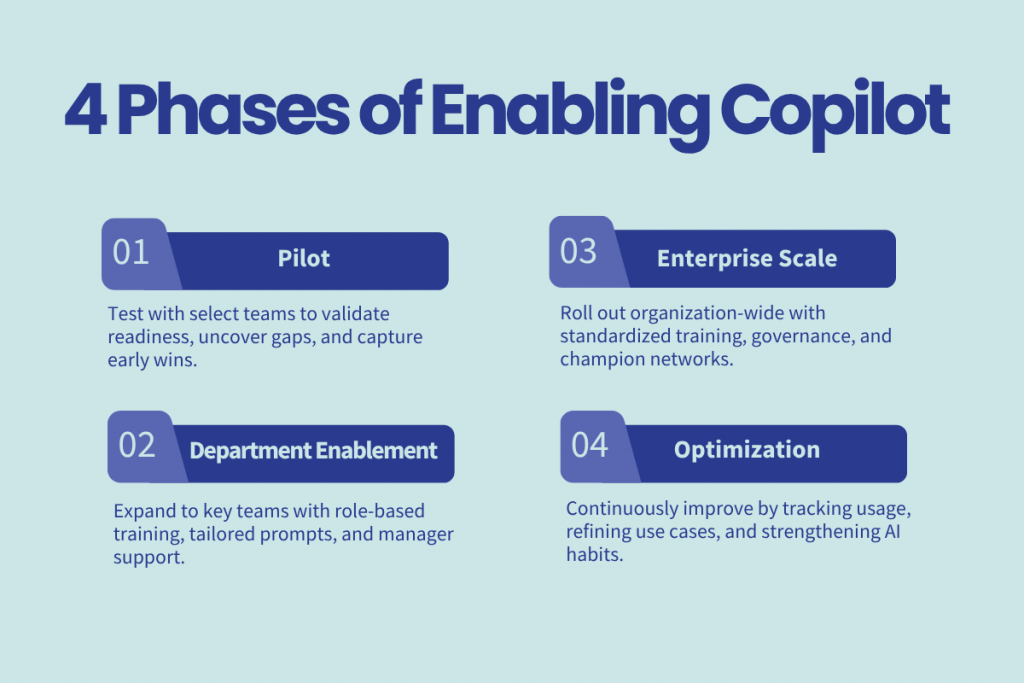
A strong adoption model should use an incremental rollout. Instead of launching to everyone at once, organizations should move through a phased structure that allows them to test, learn, improve, and scale with confidence.
A practical rollout model includes four phases:
Phase 1: Pilot
Start with high-impact teams and users who are open to experimentation. Validate technical readiness, identify friction points, collect feedback, and document early wins.
Phase 2: Department Enablement
Expand to priority departments with role-based scenarios, hands-on training, workflow-specific prompts, and manager support.
Phase 3: Enterprise Scale
Widen access across the organization with standard training, clear governance policies, champion networks, and usage reporting.
Phase 4: Optimization
Track adoption, collect feedback, refine use cases, update training, and help employees build stronger AI habits over time.
Champions are especially important in this model because they make Copilot practical. They help translate general AI capabilities into everyday work patterns, such as preparing meetings, summarizing documents, writing emails, analyzing spreadsheets, building presentations, or finding information faster.
For best outcomes, organizations should combine formal training with experiential learning. This may include launch events, quick-start sessions, role-based prompt libraries, department office hours, manager toolkits, success stories, live scenario demonstrations, prompt-a-thons, peer learning channels, and ongoing feedback loops.
The goal is not only to teach employees what Copilot can do. The goal is to help them understand where Copilot fits into their daily work, how to use it responsibly, and how to build confidence through repeated practice.
Your Content Goes Here
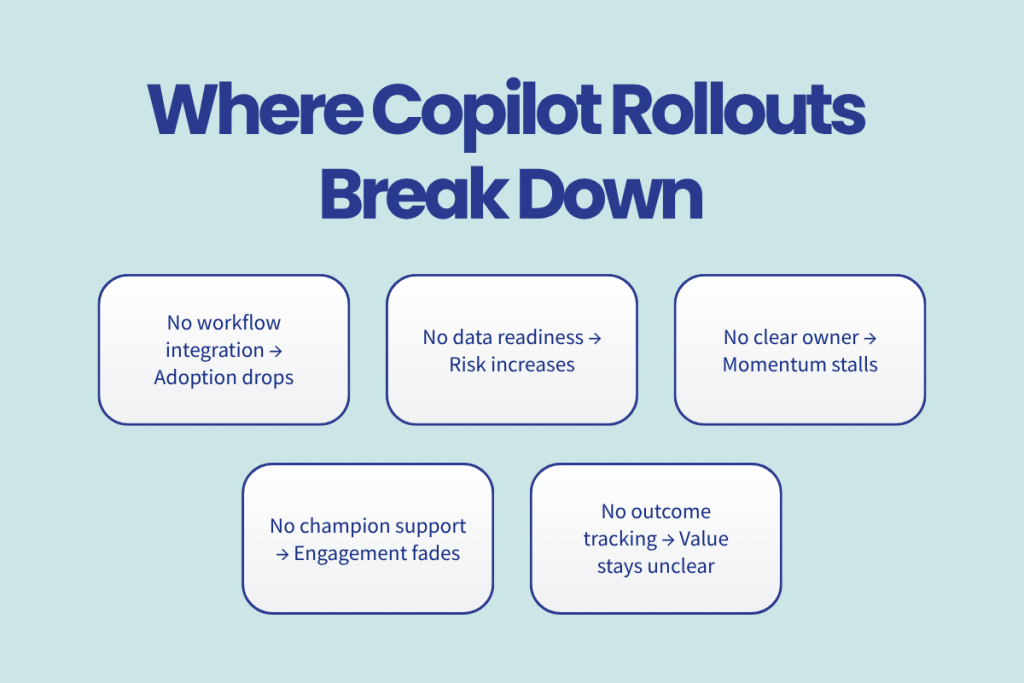
The Most Common Ways Copilot Rollouts Stall
In our experience working with organizations across their Copilot journey, the technology rarely fails. The operating model does. Here are the patterns we see most often — and what they actually signal.
Low adoption that persists past the pilot
The most common call we get six months into a rollout is some version of: people aren't using it. Licenses are assigned, the pilot is done, and Copilot sits largely untouched outside a small group of early enthusiasts. This almost always means the rollout skipped the change management layer — there was no clear answer to the employee question of where does this fit into my actual workday? Training that teaches features without connecting them to real workflows doesn't move the needle. Role-specific scenarios and champions who can model usage in context do.
Governance that arrives too late
Organizations often treat permissions, sensitivity labeling, and content hygiene as post-launch cleanup. By the time Copilot is in employees' hands, the data foundation hasn't been addressed — and Copilot will surface whatever users have access to, whether that content is current, accurate, or appropriate to share. Security and adoption readiness need to move in parallel, not in sequence.
Ownership that falls between IT and the business
Without a defined structure like a Center of Excellence, Copilot adoption tends to drift. IT assumes the business is driving it. Business teams assume IT is managing it. The result is fragmented experimentation with no consistent governance, no shared use cases, and no way to measure whether anything is working. Clear ownership isn't a bureaucratic exercise — it's what keeps the program moving.
Champions without the tools to champion
Many organizations name Copilot champions early, which is the right instinct. But champions who aren't given dedicated time, practical scenarios, and a feedback channel back to the program team quickly become figureheads. The champion network only works if it's actively supported — with prompt libraries, peer learning spaces, regular check-ins, and visible recognition.
Measuring licenses instead of outcomes
Adoption reporting that tracks only who has access tells you very little about whether Copilot is creating value. We see organizations celebrate high license assignment rates while employees in those same departments report Copilot hasn't changed how they work at all. The metrics that matter are behavioral — repeat usage, time saved, workflows that have actually changed — not just access granted.
4. How Will Security and Value Be Measured Over Time?
Scaling Copilot responsibly requires two things to move together: a secure data foundation and a measurement model that tells you whether adoption is actually creating business value. Organizations that treat these as separate workstreams — finishing security before thinking about metrics, or tracking usage before addressing governance — tend to hit the same wall. One without the other leaves you either flying blind or building on an unstable foundation.
Before expanding access, organizations should complete data and security readiness work, particularly across departments handling sensitive information. This means reviewing SharePoint permissions, addressing oversharing, improving content ownership, applying sensitivity labels where needed, and using Microsoft Purview to strengthen data protection. If content is overshared, outdated, poorly labelled, or unmanaged, Copilot will surface information that users technically have access to but shouldn't be relying on. This isn't a one-time cleanup — it's an ongoing governance discipline that needs to be owned, tracked, and reviewed as adoption grows.
Practical governance workstreams to establish alongside your rollout include:
- Permission reviews and oversharing remediation
- Sensitivity labeling and content lifecycle management
- Site ownership cleanup and compliance policy coordination
- Monitoring, reporting, and controlled experimentation environments
With the data foundation in place, measurement becomes meaningful. A scalable operating model should track three categories of outcomes:
Adoption metrics: Active users, repeat usage, department participation, training completion, and champion engagement.
Productivity metrics: Time saved, faster document creation, reduced meeting follow-up effort, improved content turnaround, and fewer repetitive tasks.
Business impact metrics: Improved employee satisfaction, faster decision-making, lower operational friction, higher output quality, and better knowledge discovery.
These metrics should be reviewed regularly by the Center of Excellence and steering committee — not to celebrate license counts, but to answer the question that matters most: is Copilot changing how work gets done, and is that change creating measurable business value?
Copilot Scale Requires an Adoption Operating Model
Microsoft 365 Copilot can create significant value, but only when organizations treat it as a transformation program rather than a tool rollout. A structured adoption operating model brings together executive sponsorship, phased deployment, secure data foundations, champions, training, governance, measurement, and continuous improvement.
The right operating model gives leaders visibility, IT control, employees confidence, and the business a defined path to measurable AI value. For organizations ready to scale Copilot, the path is clear: define ownership, prioritize the right use cases, enable people in phases, strengthen security, measure outcomes, and keep improving as usage grows.
FAQ: Frequently Asked Questions
1. What is an operating model for Microsoft 365 Copilot?
An operating model for Microsoft 365 Copilot is the structure that defines how an organization governs, deploys, adopts, measures, and improves Copilot across teams. It brings together executive sponsorship, IT readiness, security, compliance, business use cases, training, champions, and continuous improvement into one coordinated adoption framework.
2. Why do organizations need an operating model to scale Copilot?
Organizations need an operating model because Copilot adoption is more than assigning licenses. To scale successfully, companies need clear ownership, secure data foundations, user enablement, governance controls, and measurable business outcomes. Without this structure, Copilot usage can become inconsistent, fragmented, or difficult to measure.
3. Who should own Copilot adoption in an organization?
Copilot adoption should be owned by a cross-functional team, often structured as an AI Center of Excellence or Copilot Center of Excellence.This team should include executive sponsors, IT leaders, security and compliance stakeholders, business unit leaders, change management teams, and champions from priority departments.
4. What is the role of an AI Center of Excellence in Copilot adoption?
An AI Center of Excellence helps guide Copilot strategy, governance, enablement, and continuous improvement. It provides standards, prioritizes use cases, supports business teams, manages adoption risks, and ensures Copilot is aligned with enterprise goals.
5. What are the key phases of a Copilot adoption model?
A practical Copilot adoption model includes four phases: Pilot (test with early adopters), Department Enablement (expand to priority teams with role-based training), Enterprise Scale (roll out broadly with governance and champions), and Optimization (measure, refine, and improve outcomes over time).