Author
Prem Chandran
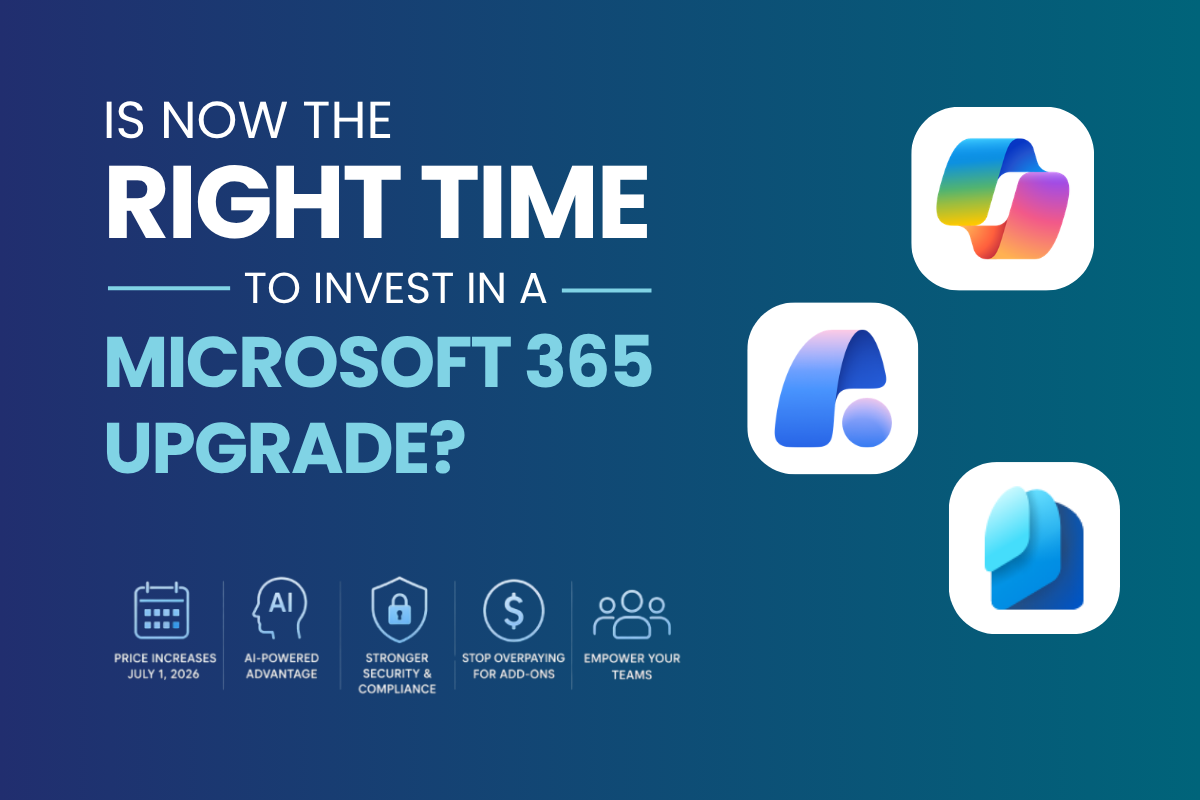
Yes, if your organization is on Microsoft 365 E3 or E5, 2026 may be the right time to upgrade. Five signals point in that direction: July 1, 2026 price increases, the arrival of Microsoft 365 E7 with bundled AI capabilities, growing security and compliance requirements, hidden add-on costs that can exceed a higher-tier plan, and rising employee demand for AI-powered tools like Copilot. A licensing assessment from a certified Microsoft partner like us can help you confirm whether an upgrade will reduce cost, strengthen security, and improve AI readiness.
Should you upgrade your Microsoft 365 plan in 2026?
If your organization is still on Microsoft 365 E3 or E5 and you have been debating whether to upgrade, 2026 is shaping up to be a pivotal decision year. Pricing changes, the expansion of Microsoft's AI stack, rising security expectations, and new productivity demands are all converging at once. Together, they make this one of the most important Microsoft 365 licensing windows organizations have faced in years.
Here are five practical signals to help you decide whether now is the right time to move from E3 to E5 or from E5 to E7.
Signal 1: How does the July 2026 Microsoft 365 price increases affect your budget?
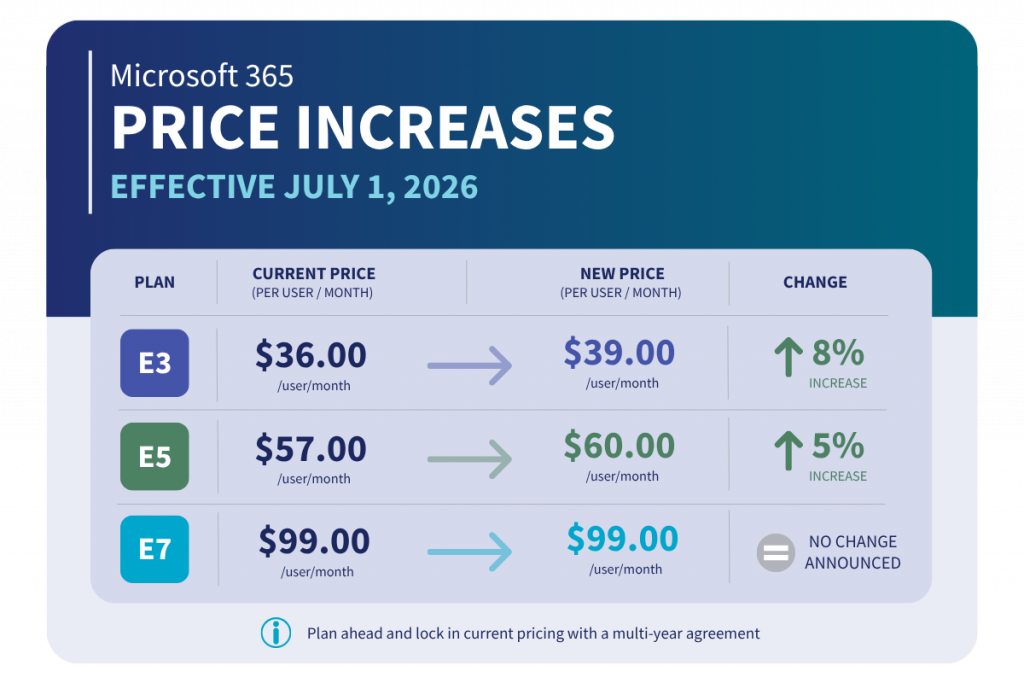
Microsoft has announced price increases effective July 1, 2026:
- E3 increases from $36.00 to $39.00/user/month – an 8% increase
- E5 increases from $57.00 to $60.00/user/month – a 5% increase
- E7 remains at $99.00/user/month with no change announced
For a 500-user organization on E5, the increase from $57.00 to $60.00/user/month represents an additional $3.00 per user per month, or approximately $18,000 in added annual licensing costs. Organizations considering an upgrade or renewal should evaluate whether locking in current pricing through a multi-year agreement provides meaningful savings.
This pricing pressure is structural, not temporary. As one industry expert explained during a recent Creospark webinar, "AI infrastructure is real money. Microsoft is investing tens of billions of dollars in GPUs, data centres, and energy capacity. That investment has to be funded, and it is being funded through the productivity stack."
Signal 2: Is the shift to AI-powered operations now essential for competitive advantage?
Microsoft's introduction of E7 on May 1, 2026, is not just a new SKU; it signals where the platform is heading strategically. E7 bundles Microsoft 365 Copilot, Agent 365, Copilot Cowork, Work IQ, and the Microsoft Entra Suite into a single enterprise plan.
E7 simplifies the decision. Instead of debating who should receive Copilot, which identity capabilities are required, and how security should scale, organizations get a bundled model built for broad AI adoption. That means flexibility, but more predictability and for organizations scaling Copilot across the business, predictability can be more valuable than incremental optimization.
In many ways, the AI question and the licensing question are now the same question. Organizations that moved early on cloud transformation gained a competitive edge; the same pattern is emerging with AI. Early adopters of Copilot and AI agents are already building operational advantages that late movers may find difficult to replicate.
Signal 3: Is your current security posture keeping up with the threat landscape?
If your organization is on E3, your security stack includes essential protections: MFA, conditional access, SSO, baseline DLP for emails and files, and core Defender antimalware, firewall, exploit, and credential guards.
However, E3 does not include the advanced protections that modern threat environments increasingly demand:
- Microsoft Defender XDR, Identity, and Office 365 Plans – advanced threat protection across identity, devices, email, and cloud apps
- Insider Risk Management – detection and response to internal threats
- Endpoint DLP and DLP for Teams Chat – preventing sensitive data leakage across collaboration tools
- Risk-Based Conditional Access and Privileged Identity Management – zero-trust access controls
- Advanced Message Encryption – protection for sensitive communications
- Automatic Sensitivity Labels – consistent classification across Microsoft 365 apps, Exchange, SharePoint, and OneDrive
For organizations in regulated industries such as finance, healthcare, energy, and government or for those with elevated cyber risk these capabilities are no longer optional enhancements. They are increasingly baseline requirements. If your organization has experienced security incidents, failed an audit, or is expanding into regulated markets, the case for upgrading becomes even stronger.
Signal 4: Are your add-on costs already exceeding a higher-tier plan?
One of the most common patterns we see across organizations is E3 customers layering on multiple add-ons over time: Copilot licenses, Power BI subscriptions, separate phone systems, and additional security tools. When those costs are aggregated, many organizations discover they are already paying more than a higher-tier plan would cost with everything bundled.
The math is straightforward: when standalone components like Copilot (approximately $30/user/month), Entra Suite, and advanced security add-ons are purchased separately on top of E5, the combined cost can reach approximately $117/user/month. E7 bundles these at approximately $99/user/month.
A licensing audit can reveal hidden savings. If your add-on spend is approaching or already exceeds the price gap between tiers, the upgrade may effectively pay for itself while also simplifying your environment and reducing administrative overhead.
Key question to ask: How many users will actually use Copilot? If you're rolling Copilot to your whole knowledge worker base, E7 is the cleaner commercial path. If you're rolling it to 20%, the add-on model is cheaper. Run the math on your specific user count before deciding.
Signal 5: Are your teams asking for better tools and AI capabilities?
Sometimes the clearest signal comes from within the organization. If employees are requesting better analytics tools, AI writing assistants, smarter search, or more integrated communication platforms, current licensing may not be keeping pace with how people want to work.
- E5 unlocks Power BI Pro for data-driven decision-making and Viva Insights for organizational analytics
- E7 adds Copilot embedded across Word, Excel, PowerPoint, Teams, and Outlook, plus Agent 365 for building and governing custom AI assistants and Copilot Cowork for collaborative AI-powered workflows
Additionally, the licensing model itself is shifting. AI agents change the cost-value equation from per-seat to per-process. One agent can serve many users or replace a licensed workflow, meaning fewer users may need a premium-tier license, but agent capacity becomes critical. Licensing decisions made this year often lock in for 12-18 months, and the agent mix will likely change within that window.
How should you approach the upgrade decision strategically?
The best upgrade decisions are strategic, not reactive. Before making a move, use this framework to evaluate cost, risk, and long-term fit:
- Assess current usage – Which features are actively used today? What's going unused?
- Audit add-on spend – Are you paying for capabilities a higher-tier plan already includes?
- Map security and compliance gaps – Are there protections your organization needs but doesn't have?
- Evaluate AI readiness – What percentage of users would benefit from Copilot? Are you ready to govern AI agents?
- Calculate total cost of ownership – Factor in savings from consolidation, productivity gains, and risk reduction.
- Segment user types – Most organizations have three to four meaningfully different user types, and licensing should reflect that rather than treating the whole organization as one persona.
Frequently Asked Questions
When do Microsoft 365 prices increase in 2026?
Microsoft 365 E3 and E5 prices increase on July 1, 2026. E3 rises from $36.00 to $39.00/user/month (8% increase), and E5 rises from $57.00 to $60.00/user/month (5% increase). E7 pricing remains at $99.00/user/month.
Should I upgrade from E3 to E5 or E7?
Upgrade to E5 if you need advanced security (Defender XDR, Insider Risk Management), compliance tools, Power BI Pro, or Teams Phone. Upgrade to E7 if you plan to deploy Copilot to most of your knowledge workforce and want bundled AI governance with Agent 365 and Entra Suite. If only 20-30% of users need Copilot, staying on E5 with add-ons is typically more economical.
What is Microsoft 365 E7, and when did it become available?
Microsoft 365 E7, called the Frontier Suite, became generally available on May 1, 2026. It includes everything in E5 plus Microsoft 365 Copilot, Agent 365, Copilot Cowork, Work IQ, and Microsoft Entra Suite designed for organizations committed to AI-powered operations at scale.
How do I know if my organization is ready for E7?
E7 is designed for organizations that plan to roll Copilot to their entire knowledge workforce and want to govern AI agents centrally. If your Copilot adoption plan covers the majority of users, E7 provides cost predictability and eliminates add-on management. If adoption is limited to a small percentage, E5 with selective add-ons remains more cost-effective.
How can Creospark help with your Microsoft 365 upgrade?
At Creospark, we help organizations make Microsoft 365 licensing decisions with greater clarity and confidence. Our team assesses your user types, compliance needs, security requirements, and AI readiness to recommend the right plan mix. We identify overspend, model upgrade scenarios, and help you build a licensing strategy that supports both immediate needs and long-term transformation.
👉 If you are reviewing your Microsoft 365 licensing strategy, book a consultation with Creospark. We can help you evaluate your current plan, identify savings opportunities, and build an upgrade path that aligns with your business goals.