Author
Prem Chandran
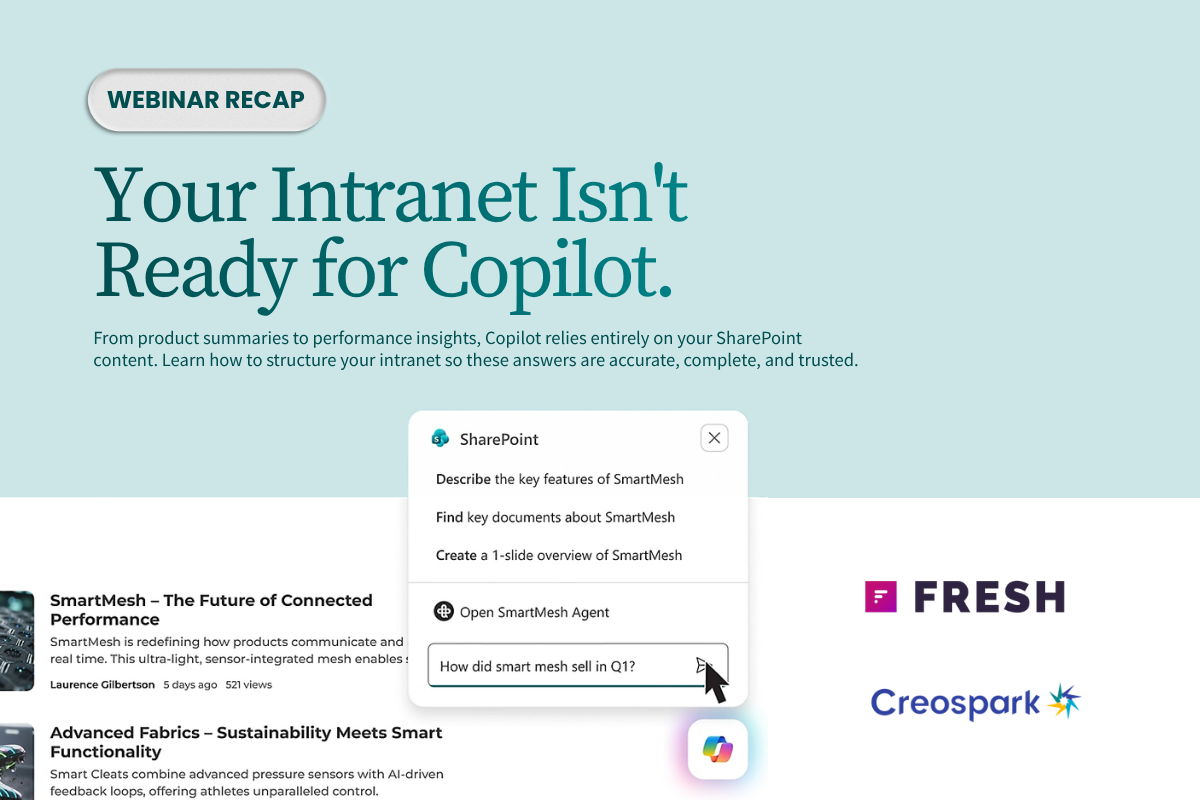
Copilot is changing how employees find and interpret information. But for many organizations, the intranet content Copilot relies on is outdated, duplicated, unowned, or poorly structured.
In our recent webinar, “Your Intranet Isn’t Ready for Copilot. Here’s What To Do First,” Creospark and Fresh explored why Copilot readiness is not just a technology project. It is also a content, governance, and trust project.
The Intranet Content Problem
Most intranets were built as employee experiences: navigation, pages, search, and announcements.
Copilot changes that model.
Instead of guiding employees through the intranet interface, Copilot goes directly to the content layer. That means outdated policies, duplicate pages, draft documents, and unowned information can all be surfaced with the same confidence as current, approved content.
Poor content is no longer hidden. It is amplified.
That naturally leads to the next question: If Copilot is grounded in your SharePoint content, what happens when that foundation isn’t ready?
The answer is already showing up across organizations:
- Outdated or irrelevant content gets surfaced in responses
- Information appears without clear context
- Users lose trust in what Copilot returns
What the Research Tells Us
The webinar highlighted a growing employee attention problem:
- Only 12% of employees read internal communications in full
- 83% say they are overloaded with content
- 95% trust AI summaries to capture key points
- 92% of internal communications professionals worry AI summaries may distort meaning or tone
This creates a major risk: employees may trust AI-generated answers at the exact moment content reliability is weakest.
Read the full Fresh Employee Attention Recession Report 2026 Here.
The Bigger Problem: The Intent Gap
The issue is not just whether content exists. It is whether the intended meaning survives when AI summarizes it.
If content lacks clear ownership, structure, metadata, or review processes, Copilot may return answers that are incomplete, outdated, or misleading.
The intranet that works for Copilot is the same one that works for employees: clear, current, trusted, and governed.
3 Pillars of Readiness
Copilot-ready intranets are built on three pillars:
Structure
Clear site architecture, taxonomy, and information organization
Content
Accurate, current, purposeful, and easy to interpret
Governance
Defined ownership, lifecycle rules, and sustainable review processes
Better governance produces better AI outputs.
What to Do First
Creospark recommended starting with practical content cleanup:
- Define what belongs on the intranet and what does not
- Identify outdated, duplicated, or superseded content
- Assign clear content ownership
- Review permissions and access
- Structure content so meaning survives summarization
- Align content governance with Microsoft 365 architectur
Frequently Asked Questions
Why does intranet content matter for Copilot?
Copilot uses the content it can access. If that content is outdated, duplicated, or poorly governed, the answers may be unreliable.
Does Copilot fix intranet content problems?
No. Copilot exposes and amplifies the content problems that already exist.
Where should organizations start?
Start with the content layer: identify high-risk pages, duplicate information, unclear ownership, and outdated policies.
What makes an intranet AI-ready?
Clear structure, trusted content, appropriate permissions, metadata, and ongoing governance.