Author
Noorez Khamis
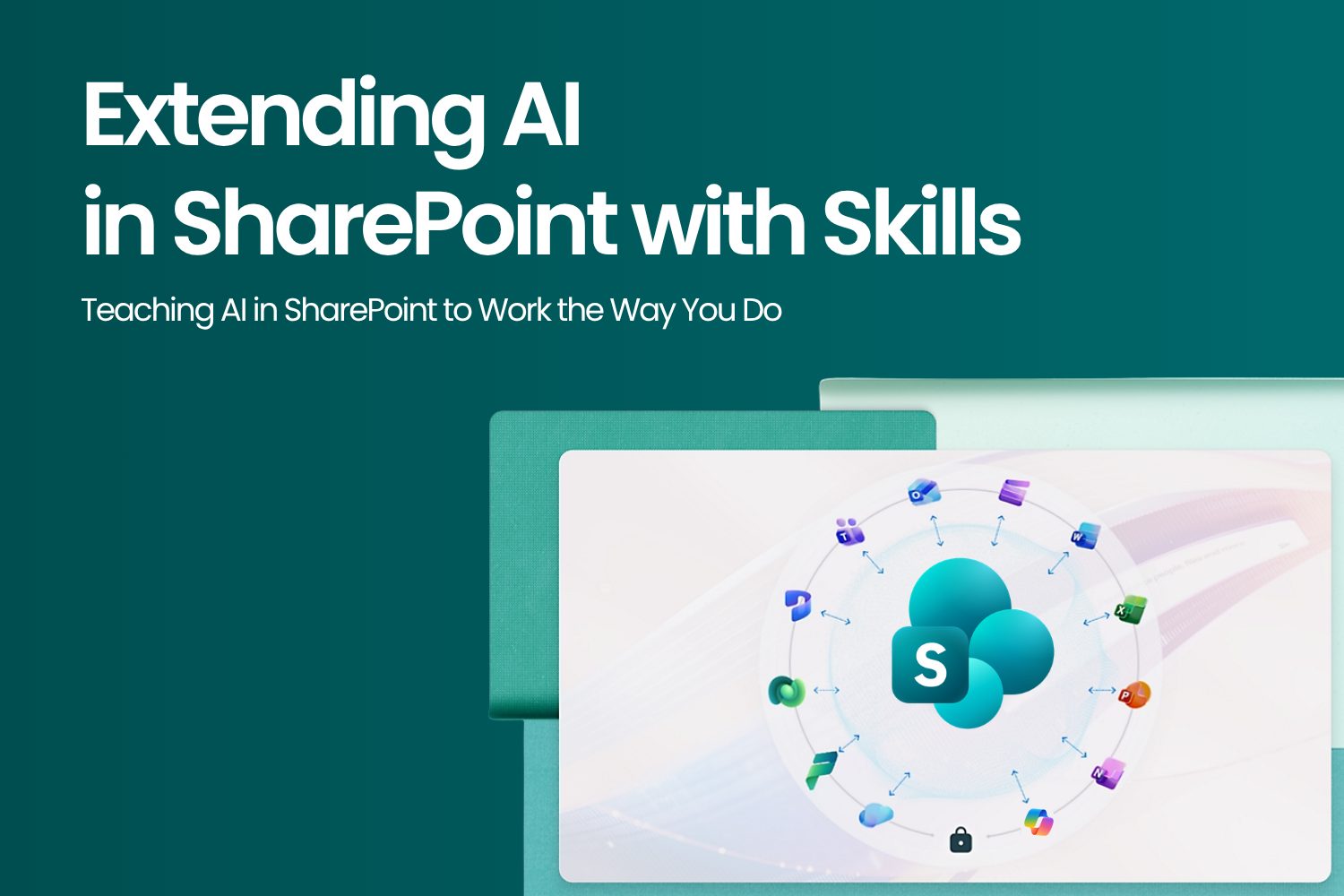
Here’s a challenge most organizations quietly wrestle with: AI tools are generic by design. They respond well to broad questions but struggle with the specifics that make your organization tick such as your naming conventions, your review processes, the way your team builds a proposal or closes out a project.
Microsoft’s latest update to AI in SharePoint, announced at the Microsoft 365 Community Conference on April 21, 2026, takes direct aim at that gap. For the first time, you can actively teach SharePoint’s AI about your organization and have it apply that understanding consistently, across your whole team, every time.
Three Things You Can Now Teach AI in SharePoint
The update introduces three interconnected capabilities, each one building on the last:
- Shared Context — What Your AI Should Always Know
Every team has unwritten rules. Style preferences. Structural standards. Terminology that’s second nature to the people who’ve been around for years but takes new hires months to absorb.
Now, you can make those rules explicit and permanent. Simply tell AI in SharePoint what it should keep in mind, and it saves that guidance at the site level, applying it automatically for every team member who uses the site going forward. One conversation with your AI becomes shared, lasting context for the whole team.
This feature is rolling out over the next two weeks to all opted-in public preview tenants.
- Skills: Repeatable Processes Your Team Can Run On Demand
If shared context is about what the AI knows, skills are about what it can do specifically, consistently, and without someone having to explain the process from scratch each time.
A skill captures a multi-step workflow in plain language. You describe the process once in chat, review the draft the AI produces, and save it. From that point on, anyone on the site can run that workflow and get the same structured output, every time.
A few ways teams are putting this into practice:
- A project team defines exactly how their tracker lists should be structured: columns, field types, acceptable values and turns that into a skill. Anyone spinning up a new project gets the right structure automatically, no manual setup required.
- A content team builds a skill that applies their information architecture standards when organizing files; correct taxonomy, right metadata, consistent folder logic without anyone having to remember the rules.
- A sales team codifies how proposals should be assembled from past content and product documentation, so every proposal starts from the same solid foundation.
- A governance or content operations team uses skills to help keep SharePoint clean and Copilot‑ready by identifying outdated content, redundant or trivial files (ROT), and documents missing required metadata so information stays current, well‑structured, and reliable for AI.
Skills are live now for all AI in SharePoint public preview tenants.
- Content Generation: Completing the Workflow
The third piece closes the loop. Rather than stopping at analysis or organization, AI in SharePoint can now take you all the way to the finished deliverable; a Word document, an Excel file, a PowerPoint deck, a structured report without leaving SharePoint and without writing a single line of code.
And because you can save that generation process as a skill, you get a repeatable pipeline. Run it once, save it, and your team has a consistent, reliable way to produce that same output whenever they need it. This capability begins rolling out in late April through May 2026.
How It All Works Behind the Scenes
All three capabilities: shared context, skills, and content generation, are stored as plain-text files, Markdown (.md) file in a dedicated Agent Assets library in your SharePoint site. They’re visible, editable, and governed just like any other document on the site.
SharePoint and OneDrive now support opening and editing these files directly in the browser, so your team can review or update shared context and skills without any developer tools. Changes can also happen naturally through chat, just tell the AI to update something, and it handles the rest.
Permissions follow your existing site model:
- Edit access → can create and update skills and context
- View access → can run skills
- Standard governance applies; retention, sensitivity labels, and audit logs all work as expected on these files
Public Preview Note: These features require an AI in SharePoint opt-in and a Microsoft 365 Copilot license. Skills are available now; shared context and content generation roll out over the coming weeks. As with any preview capability, test thoroughly before deploying to critical workflows.
What This Unlocks for Teams in Complex Industries
For organizations in legal, financial services, healthcare, and professional services, this update addresses a very real problem: critical process knowledge tends to live in the heads of a few experienced people, in documents no one consistently checks, or in prompts that produce different results depending on who wrote them.
Skills and shared context give that knowledge a permanent, usable home. Standards get enforced without enforcement. Processes run consistently without process police. New team members ramp up faster because the AI already knows how things work around here.
That’s a meaningful operational shift and it compounds over time as teams build out their library of skills and context.
From Interesting Feature to Real Value
The tools are available. The real work is figuring out where to start and which processes are inconsistent enough to be worth encoding, which knowledge is locked in too few heads, which outputs your team reproduces manually when they shouldn’t have to.
That’s where Creospark comes in. We help organizations like yours move through that discovery process quickly and strategically. Helping you identify the highest-impact opportunities, building skills and context that reflect how your team actually operates, and supporting the adoption work that turns a new capability into a lasting change.
Whether you’re exploring what’s possible or ready to build, we’re here to help you get there.
Let’s talk about what this could look like for your team.