Author
Maria Shinto
A Practical Guide
Do You Need a Skill or an Agent?
The most successful AI solutions don’t start with technology. They start with a clearly defined business need.
As organizations explore Microsoft 365 Copilot, Copilot Studio, and custom AI solutions, one question comes up repeatedly: Should you build a skill or an agent?
Choosing the right approach can simplify implementation, improve adoption, and help organizations get more value from their AI investments. The good news? The decision is often more straightforward than you might think.
Skills Teach Expertise. Agents Apply Judgment.
When evaluating AI solutions, it’s easy to get caught up in features and functionality. Instead, consider the scope of the challenge.
Are you looking to make a specific task faster and more consistent, or do you need a solution that can guide a process from start to finish?
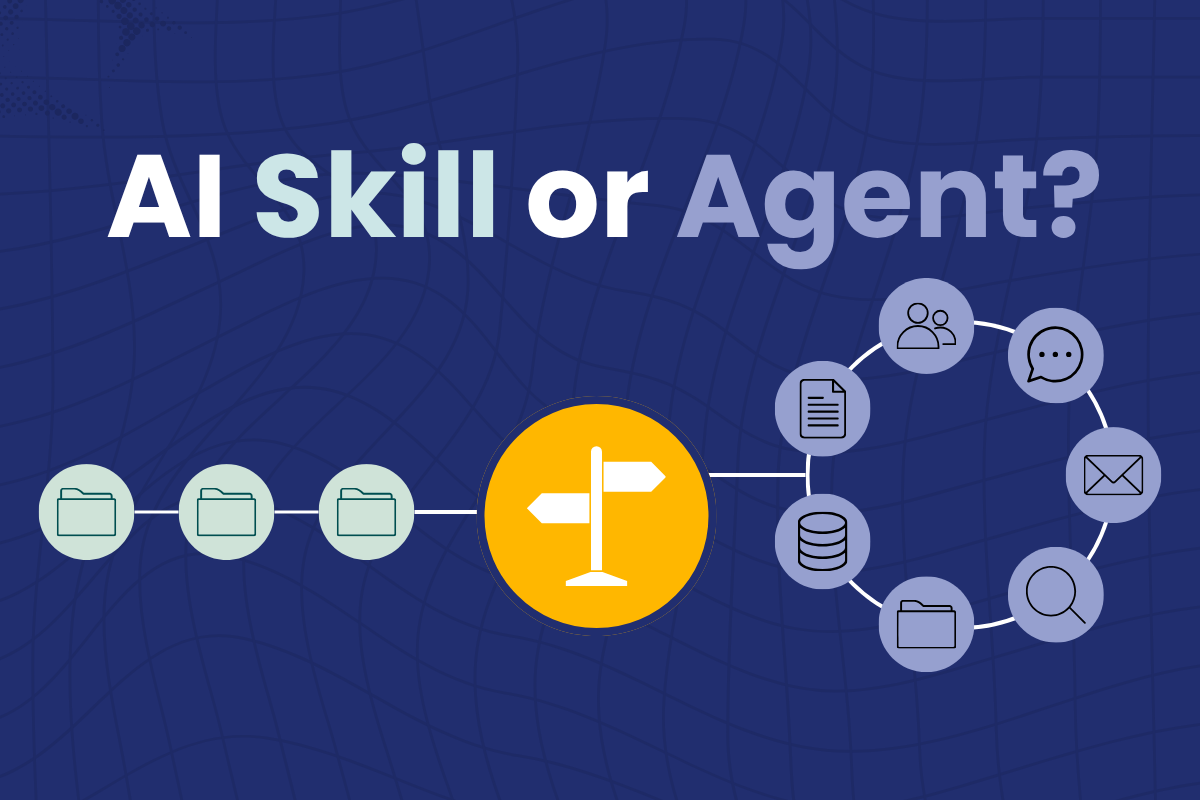
A skill teaches AI how to perform a specific task. An agent determines how to use available capabilities to achieve a broader goal.
Understanding that distinction can help eliminate unnecessary complexity and ensure you’re building the right solution for the problem at hand.
When a Skill Is the Right Choice
Skills are most valuable when there is a proven process to follow.
They work well for tasks with clear expectations, established guidelines, and repeatable steps. Rather than requiring individuals to apply the same expertise manually each time, a skill makes that knowledge reusable and easier to apply consistently.
This can help organizations reduce repetitive work, improve efficiency, and maintain quality across routine activities.
The value isn’t just completing a task faster. It’s making sure the task is completed consistently.
When an Agent Makes More Sense
Some business challenges go beyond completing a single task.
They involve multiple steps, changing information, and decisions that depend on what happens along the way.
A useful question to ask is:
“Does this solution need to make decisions along the way?”
If the answer is yes, an agent may be the better fit.
Unlike a skill that supports a defined task, an agent can interpret context, evaluate available information, and coordinate multiple capabilities to work toward a broader goal.
Its value comes from helping organizations manage more complex workflows where the next step may depend on changing requirements or information.
A Practical Decision Framework
If you’re evaluating a new AI use case, these three questions can help guide your decision.
1. What are you trying to improve?
If the goal is to complete a specific task more efficiently or consistently, a skill may be the right choice.
If the goal involves several connected activities, consider an agent.
2. Does the process already exist?
Well-defined and repeatable processes are strong candidates for skills. If employees already follow standard instructions or guidelines, those steps may be captured in a reusable capability.
If the process involves multiple systems, changing requirements, or different paths depending on the situation, an agent may provide more value.
3. Does the solution need to adapt?
Not every AI solution needs to make decisions or coordinate actions.
If the task follows a consistent set of instructions, adding an agent may introduce unnecessary complexity.
However, if the solution needs to interpret context, select next steps, or coordinate multiple activities, an agent may be a better fit.
The Best Solutions Often Use Both
The most effective AI solutions rarely come down to choosing one or the other.
Instead, think about how they work together.
Skills give AI specialized capabilities. Agents determine when those capabilities should be used. One provides the expertise, the other provides the direction.
That’s often where the greatest business value is created.
Final Thoughts
Not every task needs an agent, and not every process can be handled by a single skill. If you’re looking to make a repeatable task faster, more consistent, and easier to scale, a skill may be all you need.
If you’re trying to support a broader outcome that requires context, decisions, and coordination, an agent may be the better fit. And sometimes, the strongest solution combines both.
The best AI solutions aren’t defined by how intelligent they are. They’re defined by how effectively they solve a business problem.
Ready to Turn AI Potential Into Business Value?
The question isn’t whether your organization should use AI. It’s where AI can create the greatest impact.
Before building agents, workflows, or custom Copilot solutions, you need a clear understanding of your processes, content, governance, and automation opportunities.
Creospark’s AI Readiness Assessment helps identify high-value AI opportunities, prioritize capabilities, and create a practical adoption roadmap.
From Microsoft 365 Copilot to skills, agents, and automation, identify the capabilities that will have the greatest impact. Successful AI initiatives start with readiness.