Author
Prem Chandran
The AI-Ready Organization
Why AI Readiness Decides Who Wins in 2027
Most companies keep asking whether AI is ready for business. That is no longer the useful question. Copilots, agents, and AI-powered workflows are already capable of meaningful work. The question that matters now is whether your business is ready for AI.
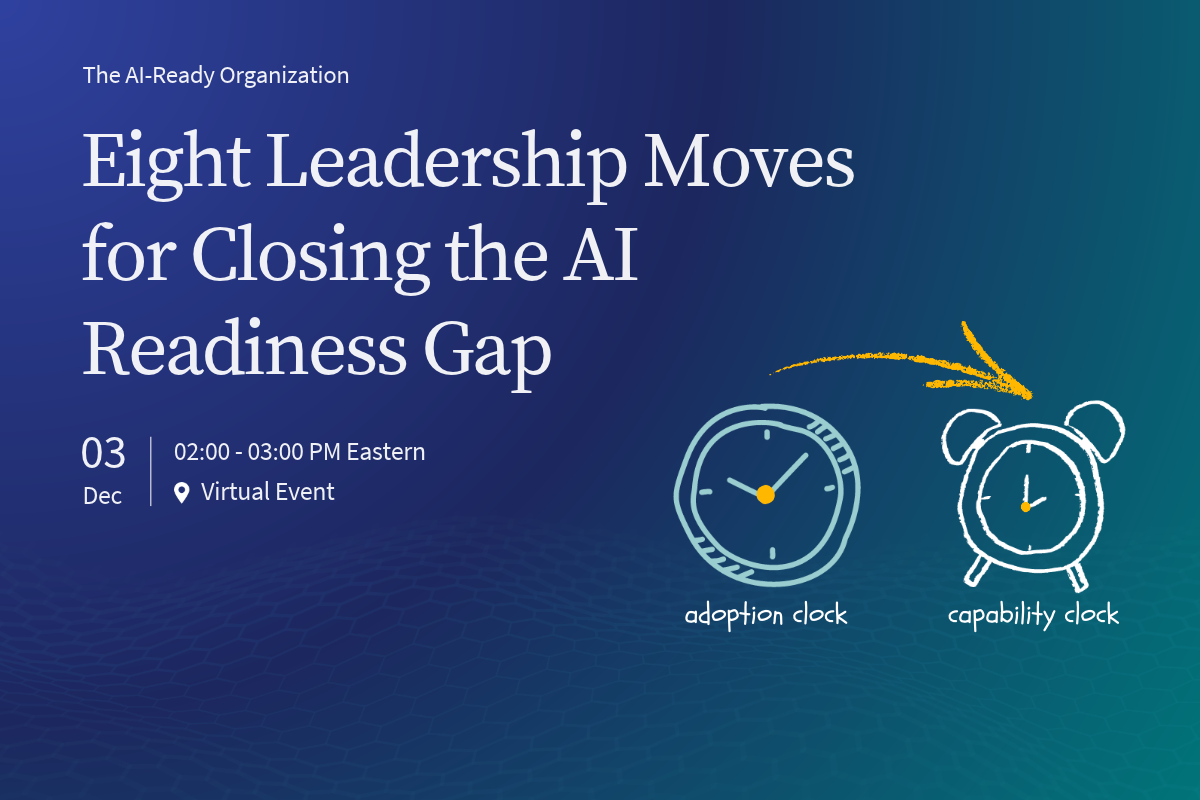
At Creospark, we think of this challenge as two clocks. The capability clock is set by Microsoft and the wider AI market, and it is sprinting. The adoption clock is set by leadership alignment, governance, permissions, information quality, workforce readiness, and operating discipline. For most organizations, the capability clock is lapping the adoption clock.
The data shows what that gap costs. Adoption is now mainstream, but value isn’t keeping up:
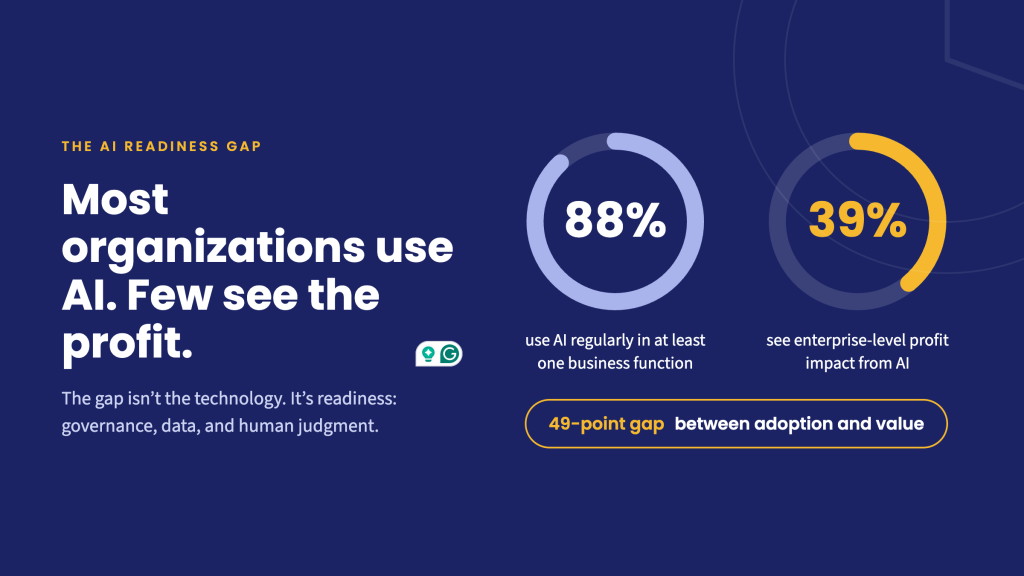
None of that is a model problem. It’s a readiness problem, and governance sits at the center of it.
Join us live on December 3
Learn how to close the gap between what AI can do and what your organization is ready to govern and scale.
Eight leadership moves for closing the gap
Trying to govern AI one feature at a time is a race organizations cannot win. Leaders need durable foundations: identity ownership, data accountability, clear guardrails, and a roadmap that matches the pace of rollout to the organization’s ability to absorb change.
In our live session, we’ll break down all eight moves:
(1) align readiness with capability, (2) build judgment, (3) improve prioritization, (4) govern agents, (5) fix the information environment, (6) replace fear with governance, (7) redesign how expertise is developed, and (8) build one readiness operating model. Here is a preview of six of them.
Move 1: Align organizational readiness with AI capability
The instinct is to close the gap by picking a better platform. That’s not the fix. Leaders should start with a readiness assessment instead of a technology selection: give one executive real ownership of AI adoption, define the business outcome before choosing a tool, take an honest look at governance, data, and workforce readiness, and pace the rollout to what the organization can absorb. This isn’t about slowing adoption down. It’s about making readiness grow at close to the same speed as capability.
Move 2: Build judgment, not just prompt skills
AI is a multiplier of the judgment people already bring. Experienced professionals can accelerate dramatically, while inexperienced users can produce weak work faster and with more confidence. Training must develop verification, review, context, and decision quality, not just tool familiarity.
Move 3: Improve prioritization as fast as productivity
As the cost of execution falls, generating more output stops being a competitive advantage. The bottleneck moves to attention and choice. Leaders need clearer decision frameworks, stronger outcome measures, and the discipline to stop low-value work that AI merely makes faster.
Move 4: Put agent boundaries in controls, not prompts
Agent instructions are cooperation, not enforcement. Reliable systems use deterministic permissions and code for the boundaries that cannot be crossed, while a human authority approves those boundaries and material changes. Leaders must govern what agents can access, what they can do, who remains accountable, and where approval is required.
Microsoft Agent 365 gives leaders a control plane for this: an inventory of every agent in the tenant, a named owner for each, and access governed through Microsoft Entra, just like any other identity.
Move 5: Fix the information environment Copilot will reveal
Copilot does not invent oversharing, unclear ownership, stale content, or weak permissions. It simply makes them easier to discover. Organizations must review access, ownership, classification, retention, and content quality before broad rollout so Copilot creates value without amplifying existing risks.
Microsoft Purview sensitivity labels, data loss prevention, and retention policies, together with SharePoint Advanced Management, are how you find and fix these issues before Copilot surfaces them.
Moves 7 and 8: Redesign expertise and build one readiness operating model
AI is changing the first rung of many careers from producing a first draft to judging and directing one. Organizations need to modernize onboarding, build AI-assisted apprenticeship, and teach validation as a core skill. From there, workforce development, information architecture, governance, security, and data quality must connect into one repeatable operating model, rather than a separate project for every new capability.
What you’ll walk away with on
Beyond exploring all eight leadership moves, this practical session will help you:
- Pinpoint your highest-priority gap between AI capability and organizational readiness.
- Establish practical guardrails for Microsoft Copilot and AI agents using Microsoft Agent 365 and Microsoft Purview.
- Align leadership and IT around a single, scalable AI readiness operating model.
- Get your specific questions answered during our live interactive Q&A.