Author
Aashavi Mistry

Early this year, Microsoft signaled a potential Microsoft 365 E7 licensing tier. For years, enterprise customers have speculated whether an E7 plan would follow E5, especially as Microsoft continues layering separately priced capability onto existing plans.
Initially, the idea seemed unlikely. The January 2026 episode of Directions on Microsoft podcast suggested that Microsoft was instead pushing for an advanced Intune and Defender capabilities down into E3 and E5, reducing the need for a premium tier.
At the same time, Microsoft confirmed that E3 and E5 prices would increase by $3 per user per month starting in July 2026, releasing the new bundled features but also increasing pressure on enterprise budgets.
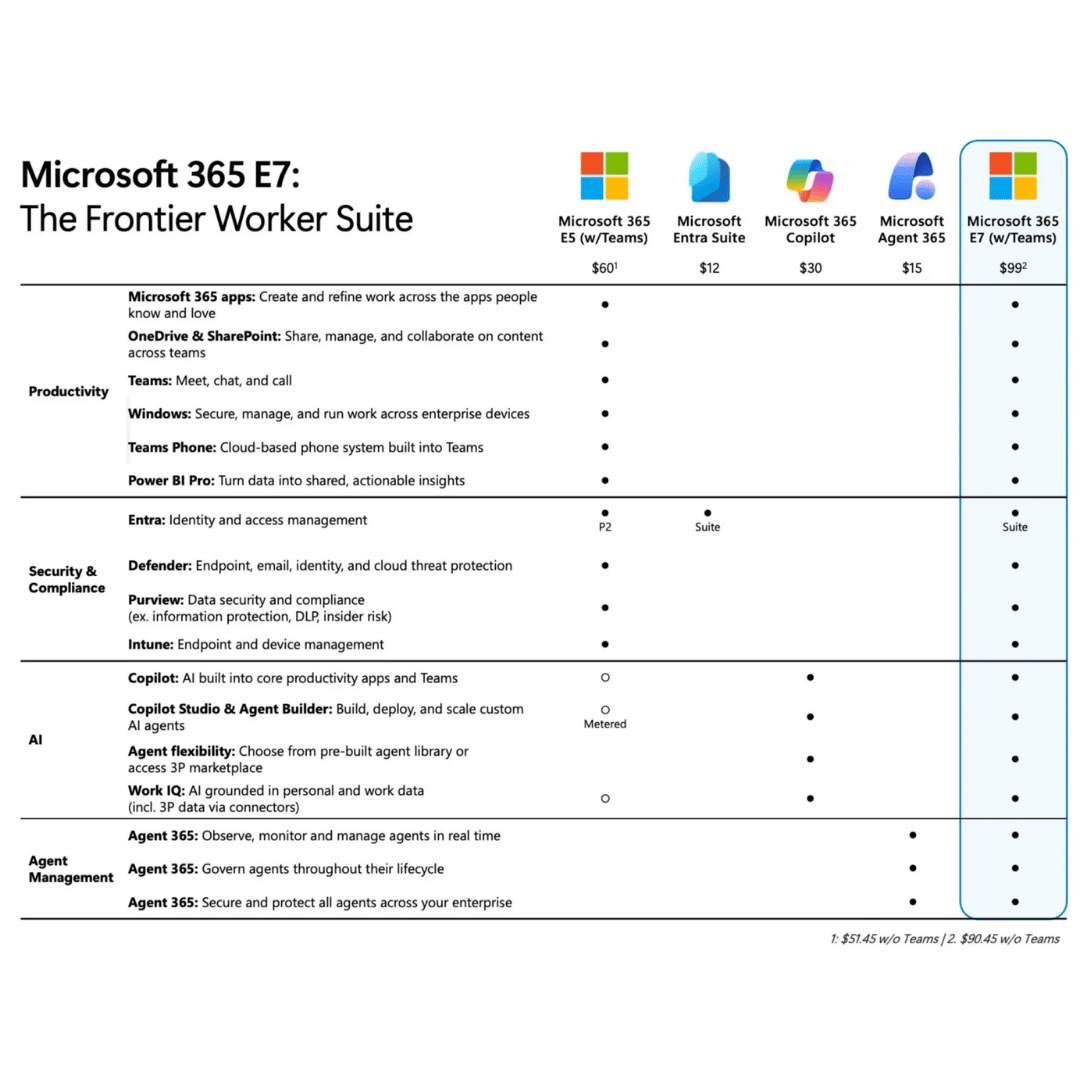
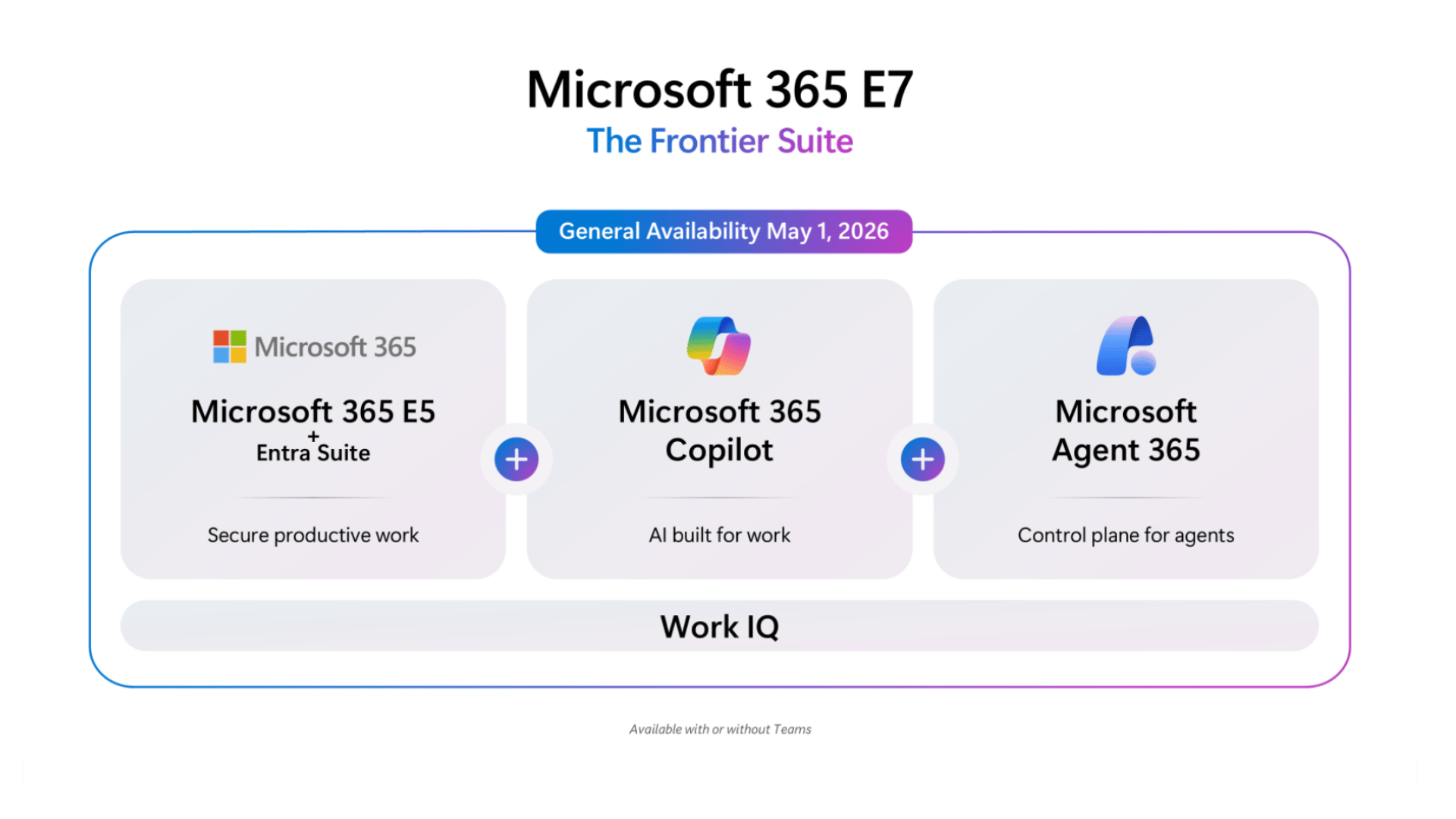
Then, as of March 9th, 2026, things became clear. Microsoft officially announced Microsoft 365 E7, The Frontier Suite, alongside the general availability of Agent 365, confirming E7 as the company's new top-tier enterprise offering. E7 brings together Microsoft 365 E5, Microsoft 365 Copilot, the Entra Suite, advanced Defender, Intune, Purview, and the new Agent 365 control plane into a single, AI platform designed for a human-led, agent-operated enterprise.
This is no longer a speculation. E7 is here, launching on May 1, 2026 at $99 per user per month, with Agent 365 also becoming generally available the same day for $15 per user. Early descriptions from Microsoft and industry partners consistently position E7 as far more than a licensing bundle, it represents Microsoft's shift towards AI as the core enterprise platform. Which will unify Copilot, digital agents, identity, security, and compliance into a single, governed foundation for AI-driven work.
From AI Tools to an AI Platform
AI within Microsoft 365 has existed as an optional enhancement for productivity assistants, chatbots, or workflow helpers on top of existing applications.
The structure of E7 suggests that Microsoft appears to be positional AI as a foundational capability across the entire platform, not just as a feature.
- AI agents as digital employees:
- A key element of the E7 bundle is Agent 365, a framework that is designed to help organizations create, manage, and govern AI agents that function like digital worker.
- These agents could interact with enterprise systems like human employees by accessing tools such as email, Teams, OneDrive, and internal applications.
- These agents are described as software entities capable of planning, acting and collaborating across workflows. To function safely inside organizations, they require enterprise-level governance including:
- Entra identities
- Policy-based access control
- Telemetry and monitoring
- Security protections through Defender
- Compliance oversight thought Purview
- This concept is beyond what Copilot as a productivity assistant can do. The AI instead becomes part of the workforce by operating independently and at scale.
- Copilot becomes a core capability:
- Adopting Copilot has been slower than Microsoft initially thought. Currently it is estimated that only about 3.3% of Microsoft 365 commercial users have purchased Copilot licenses. So, building Copilot with E7 could change that.
- Rather than having Copilot be a $30 add-on, it could become a default enterprise capability for organizations embracing AI-driven workflows.
Security and Governance
As AI agents become digital workers, governance becomes important. This is where Microsoft's identity, compliance and security tools are used. Entra, Purview and Defender form the foundation of a unified agentic security framework.
- Entra:
- Microsoft appears to be treating AI agents as full identity objects within Entra. Each agent can be assigned its own identity with conditional access policies, lifecycle management and role-based permissions.
- This allows enterprise architecture to an identity-first model, where identity systems determine what both humans and AI agents can access.
- Purview:
- As AI systems interact with the enterprise data, governance becomes critical.
- Microsoft Purview has already began expanding to support different types of AI scenarios, like:
- Data Security Posture Management (DSPM) for AI.
- Sensitivity labels applied to AI interactions
- Data Loss Presentation policies tied to agent behavior
- AI-specific risk assessments and compliance guidance
- These capabilities ensure that organizations maintain visibility and control over how AI systems access and use their sensitive information.
- Defender:
- Microsoft Defender provides:
- Security telemetry for AI activity
- Behavioral monitoring and anomaly detection
- Unified threat detection across human and digital identities
- Microsoft Defender provides:
What this means for Organizations
The potential arrival of E7 could be a beginning of a new enterprise operating system, one where AI is not a productivity add-on, but part of the core infrastructure.
- AI strategy must become identity-driven because AI agents require structed identity and access management, organizations will need to align:
- AI strategy
- Identity architecture
- Access governance
- Data classification
- Security and compliance will evolve. As organizations start adopting AI at a larger scale, it will need stronger governance, including:
- Advanced data governance programs
- AI-specific security monitoring
- Continuous oversight of agent activity
- Updated regulatory compliance processes
- Microsoft 365 will evolve:
- For many organizations, E3 and E5 will remain sufficient for traditional work. However, enterprises planning to deploy large-scale automation or digital agents may use E7, since it integrates the identity, governance and security capabilities need to manage hybrid human-AI environments.
Why This Matters
E7 licensing is Something enterprises cannot ignore because:
- AI is becoming infrastructure: AI will require formal budgeting, IT governance, and long-term architectural planning.
- Digital workers will reshape enterprise operations: As AI agents become embedded in workflows, organizations must prepare for hybrid teams of humans and AI systems.
- Governance framework must evolve: Policies around data access, AI decisions, and management will be important.
- Early adopters will gain competitive advantages: Organizations that invest early in identity governance, security readiness, and data foundations will be better prepared to scale to AI safely and quickly.