An Executive Guide to AI Readiness2026-09-22T16:49:33-04:00
WHITEPAPER – AN EXECUTIVE GUIDE TO AI READINESS

Why AI Readiness, Not AI Capability, Decides Who Wins

AI tools are becoming more powerful every day. Yet most organizations struggle to turn AI investments into measurable business value because readiness gaps in governance, skills, leadership alignment, and change management slow adoption.

This executive guide explains why successful AI adoption depends less on technology and more on organizational readiness.

In this whitepaper, you’ll learn:

  • Why AI capability alone does not create business value
  • The five readiness gaps preventing successful AI adoption
  • How to prepare your Microsoft 365 environment for AI
  • Governance and risk management considerations for responsible AI
  • Practical steps to build workforce readiness and confidence
  • A framework for moving from experimentation to business impact

Ideal For
CIOs and IT Leaders, Digital Transformation Leaders, Business Executives, Microsoft 365 Decision Makers
AI & Innovation Teams.

Download the whitepaper to discover how leading orgs are preparing for long-term AI success.

AI is ready. Is your organization?

Most companies continue to ask whether AI is ready for business. The more important question is whether the business is ready for AI. New copilots, agents, models, and AI-enabled applications are arriving faster than many organizations can evaluate, govern, and operationalize them. This creates two different clocks:

  • The capability clock, driven by the rapid development of AI technology
  • The adoption clock, driven by governance, leadership alignment, security, training, and operational readiness
    When these clocks move at different speeds, risk grows and business value becomes harder to achieve.
Microsoft 365 Copilot Readiness for Success

The Adoption-Value Gap

0%
Organizations report regular AI use in at least one business function.
0%
Can point to enterprise-level profit impact from AI.
0%+
Estimated AI project failure rate, while only 14% feel fully ready.
0%
Enterprise leaders use generative AI weekly, but only 72% formally track ROI.

The difference between AI use and AI value is not simply access to technology. The whitepaper argues that the organizations creating durable value are investing in training, governance, hiring, rollout design, information architecture, and leadership accountability.
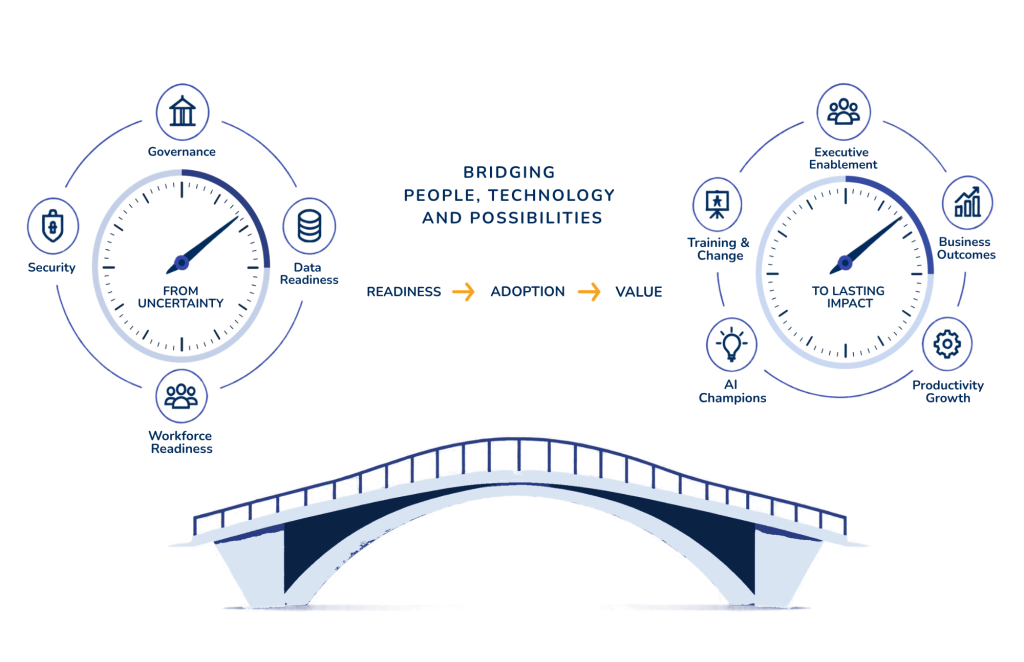
AI readiness framework showing the journey from readiness to adoption and business value.

This whitepaper explores the leadership decisions that help organizations

  • Turn AI experimentation into measurable business value
  • Reduce governance and security uncertainty before it becomes a business risk.
  • Scale AI adoption with greater confidence and executive alignment
  • Build a workforce capable of working effectively alongside AI.
  • Create a sustainable foundation for Microsoft Copilot, AI agents, and future AI investments
  • Move from reactive AI conversations to a repeatable operating model for success.

Discover the Six Foundations that determine whether AI initiatives scale successfully across the organization.

Who Benefits from a Copilot Agent Proof of Concept?

Move from insight to an actionable roadmap

The whitepaper introduces Creospark’s AI Discovery & Roadmap Jumpstart as a structured engagement intended to help leaders identify AI opportunities, review their information landscape, prioritize value and feasibility, and create a leadership-ready roadmap.

AI opportunity inventory 

  • Data landscape review 
  • Value and feasibility prioritization 
  • Prioritized AI roadmap
  • Executive recommendation 

Frequently Asked Questions
AI readiness is the organizational ability to introduce and scale AI responsibly through leadership, governance, security, information architecture, data quality, workforce capability, and change management. 

AI capabilities are largely supplied by technology vendors. Business outcomes depend on whether an organization can select appropriate opportunities, govern access, prepare its information environment, train employees, and remain accountable for results. 

The whitepaper argues that Copilot frequently reveals existing governance issues rather than creating them. Copilot works within existing Microsoft 365 permissions, which makes permission hygiene, content ownership, information lifecycle management, and classification especially important.  

Organizations should document what agents can access, what actions they may perform, where human approval is required, how activity is monitored, and who is accountable when something goes wrong.  

The whitepaper recommends beginning with a readiness assessment that examines leadership ownership, governance, data, information architecture, security, workforce readiness, adoption, and potential business outcomes.  

Ready to assess your AI readiness?

Identify where your organization is prepared to scale AI,where gaps remain, and what to prioritize next.

AI Insights

Go to Top