Author
Carolyn Gjerde
Welcome to Day 4 of Creospark’s 12 Days of AI, a December series exploring how artificial intelligence is transforming the way we work, create, and solve problems. Each story in this series highlights a real-world example of AI in action, how it’s helping teams across our community work smarter, faster, and more creatively.
At Microsoft Ignite 2025, Judson Althoff, CEO, Microsoft Commercial Business, captured the essence of this shift perfectly:
“AI isn’t here to automate what we already do—it’s here to help us do what we could never do before.”
That message sits at the heart of this story. Project management has always been about foresight, anticipating risks, aligning priorities, and keeping teams moving in sync. Yet even with modern tools, planning has remained largely manual and reactive. Project managers spend hours maintaining timelines, updating dashboards, and piecing together fragments of information from across their digital workspace—time that could be spent guiding outcomes instead of tracking them.
Now, that’s changing. AI is introducing a new rhythm to planning—one that adapts, learns, and looks ahead. With tools like Microsoft Copilot, Planner, and the new Work IQ intelligence layer, project plans are no longer static documents. They’re dynamic, context-aware systems that recognize patterns and surface insights long before they appear in a status report.
This is the next leap for project managers: a future where planning doesn’t just keep up with change—it anticipates it.
At Creospark, we’re not waiting for the AI future to arrive—we’re actively building toward it.
For all its structure and rigor, traditional project planning carries an uncomfortable truth: a plan is only as accurate as the moment it was last updated. Every shift in scope, delayed decision, or surprise dependency begins to erode its reliability. By the time a project manager revises tasks and circulates the latest version, reality has already moved on.
The complexity of modern work amplifies this challenge. Teams are distributed across time zones, projects run on multiple platforms, and critical information lives everywhere; emails, chats, documents, dashboards. Planning becomes less about guiding the work and more about chasing it. The more data we collect, the harder it becomes to see the full picture.
Even the best tools can’t close that gap when they depend on manual inputs and static assumptions. Risks are identified only after they happen. Bottlenecks surface when deadlines slip. Reports summarize the past, not the future. Experienced project managers have learned to navigate these uncertainties with intuition and persistence, but the process remains reactive by design.
That’s where AI begins to make the difference. Instead of waiting for updates, it learns from the signals already flowing through your ecosystem—communications, task histories, resource patterns—and turns them into proactive insights. It doesn’t just keep the plan current; it helps the plan stay alive.
AI is quietly redefining what it means to plan. A project plan is no longer a static document, it’s becoming a living system that learns, adapts, and reasons across your organization’s data. This is what we mean by smarter planning: shifting from managing tasks to orchestrating insight.
That shift is already underway across the Microsoft ecosystem. At Ignite 2025, the vision was clear: AI is becoming the connective tissue between people, tools, and work itself. New capabilities like Work IQ in Microsoft 365 create an intelligent layer that understands context across files, meetings, and conversations—surfacing connections that once took hours to uncover. Copilot in Project and Planner brings that same intelligence directly into a project manager’s daily workflow, generating draft plans, identifying dependencies, and summarizing updates using natural language. And the newly introduced AI Agents extend these capabilities even further, automating repetitive coordination tasks that often slow projects down.
Together, these innovations signal a fundamental change. Planning is no longer about creating the perfect timeline—it’s about maintaining a responsive system that evolves with the work itself. Imagine a project assistant that notices when a milestone might slip based on recent activity, or one that automatically summarizes progress and risks across Teams, Planner, and Power BI.
This is where smarter planning takes hold. AI doesn’t replace the project manager—it becomes a co-planner, helping teams see around corners, anticipate impact, and make better decisions in the moments that matter most.
At Creospark, we’re not waiting for the AI future to arrive—we’re actively building toward it. Across our ePMO and delivery teams, the idea of “smarter planning” has moved beyond theory. It’s taking shape in the tools we use every day, the workflows we’re refining, and the pilots already underway.
We’ve started by strengthening the foundation. Our ePMO SOP modernization effort is standardizing how we capture project data—from schedules and risks to time tracking and outcomes—so it’s consistent, structured, and ready for intelligent systems to reason over. It may sound simple, but this groundwork is critical: AI can only be as smart as the information it’s built on.
In parallel, we’re piloting Microsoft 365 Copilot within Teams and Planner to handle the everyday coordination that quietly consumes hours each week, summarizing meetings, capturing action items, and turning updates into project tasks. We’re also designing automation within our SPARK lifecycle to generate RAID logs, milestone trackers, and other project artifacts automatically. These early efforts are already hinting at a future where project managers spend more time steering outcomes and less time stitching together data.
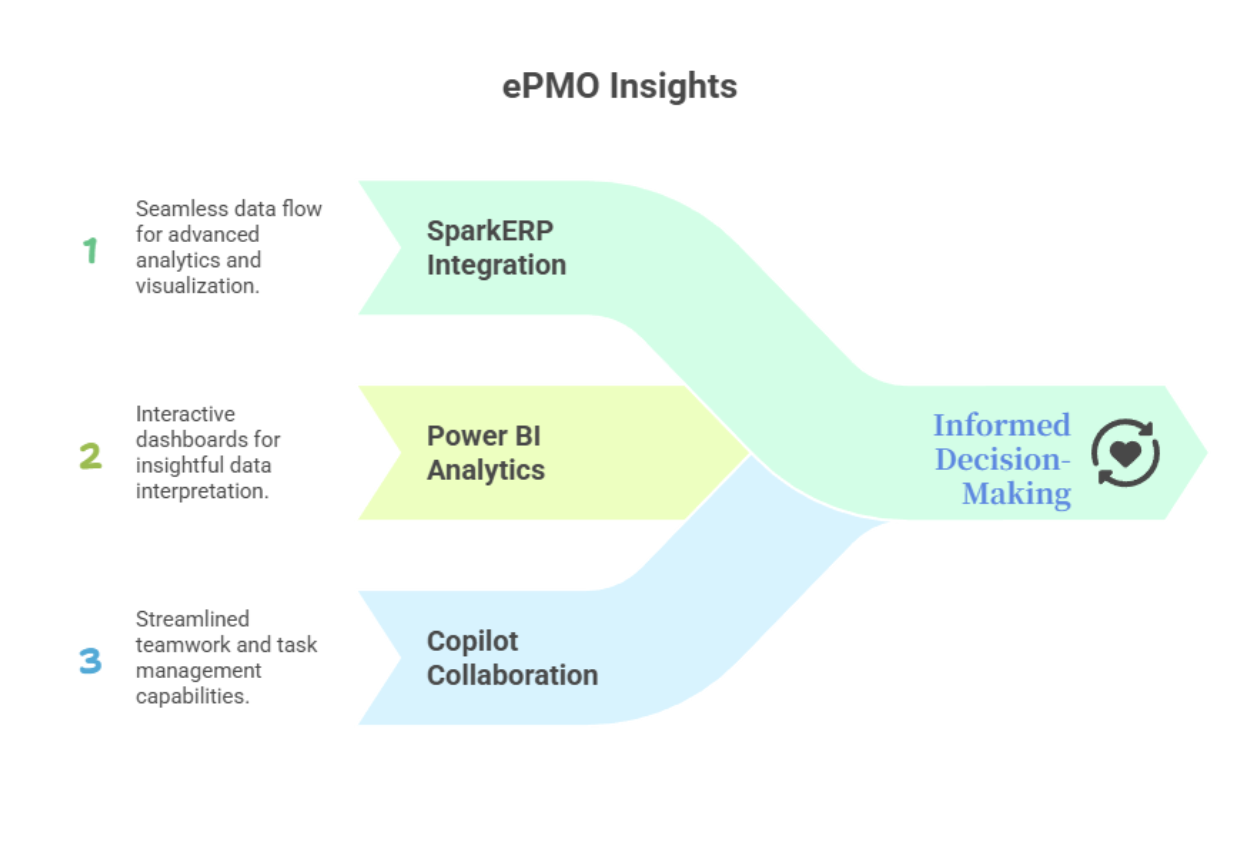
Looking ahead to 2026, the goal is clear: reclaim hours of manual administration while gaining a more predictive view of delivery. We’re developing Power BI dashboards connected to SparkERP to surface workload balance and forecast resource needs. As Copilot and Work IQ continue to evolve, we expect them to weave intelligence directly into our planning rhythm—flagging potential risks, suggesting next steps, and spotting project drift before it happens.
It’s a gradual transformation, but the direction is unmistakable. By mid-2026, we expect AI to play a measurable role in how we plan, forecast, and communicate across projects. Each iteration brings us closer to a model where planning doesn’t just react to change—it evolves with it.
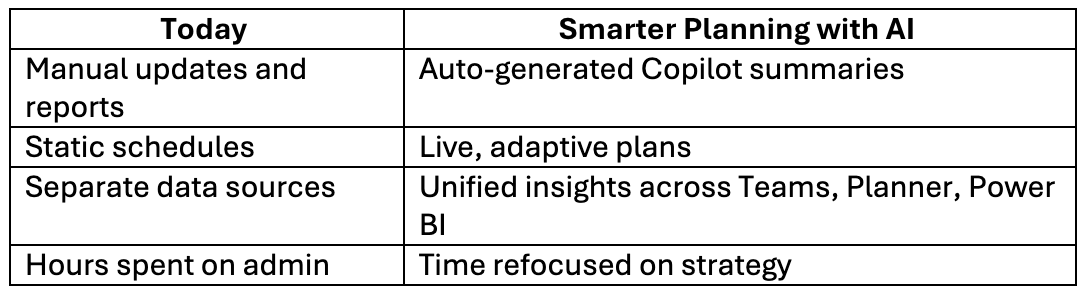
The shift toward smarter planning isn’t about replacing how we work—it’s about removing the friction that slows us down. Today, project managers still spend much of their week gathering updates, reconciling schedules, and preparing reports that are outdated almost as soon as they’re finished. These activities are essential, but they’re rarely strategic. They keep projects moving, but they don’t always move the organization forward.
In the next phase of our transformation, those same tasks will start to look very different. Instead of manually compiling updates, Copilot will summarize the latest conversations, task completions, and decisions across Teams, Planner, and Project. Instead of chasing data from multiple systems, Power BI dashboards will visualize workload balance and delivery velocity in real time. Project plans will refresh themselves, shaped continuously by live inputs rather than static assumptions.
The change isn’t just about efficiency—it’s about perspective. When updates and reporting happen automatically, project managers gain time and space to focus on what truly matters: anticipating risks, guiding decisions, and aligning outcomes with business goals. The plan becomes less of a snapshot and more of a living reflection of progress—one that adapts as the work evolves.
We’re already seeing the first signs of this shift. Early Copilot pilots are saving minutes that add up to hours, and automation inside our SPARK lifecycle is reducing repetitive setup work. By mid-2026, those savings will translate into days—because AI will finally be doing what it does best: keeping pace with change.
As this transformation continues, one truth is becoming clear: AI isn’t taking over project management—it’s redefining what great project management looks like. The real value of a project manager has never been about how quickly they can update a timeline or prepare a report; it’s about how clearly they can see what’s ahead. AI simply extends that vision.
Tools like Microsoft Copilot and Work IQ are evolving from digital assistants into strategic partners, translating scattered information into context and surfacing insights when they matter most. They help project managers spend less time maintaining process and more time leading outcomes. The human role shifts from inputting data to interpreting it—from managing updates to managing understanding.
This reflects exactly what Judson Althoff described at Microsoft Ignite 2025:
“AI isn’t here to automate what we already do—it’s here to help us do what we couldn’t before.”
For project leaders, that means moving beyond reactive coordination toward proactive guidance—using data and intelligence not just to stay on schedule, but to anticipate challenges, optimize delivery, and connect people around shared priorities in real time.
At Creospark, we see this as the next evolution of leadership in delivery. The most effective project managers in the AI era will blend intuition with insight—knowing when to trust the data, and when to question it. AI provides the signal, but it’s still human judgment that turns that signal into action.
The promise isn’t that AI will make projects easier—it’s that it will make them smarter. And that’s a future worth planning for.
The evolution toward AI-driven planning isn’t just a technology story—it’s a people story. Every step forward depends on curiosity, experimentation, and the willingness to rethink familiar habits. The project managers, analysts, and delivery leads who lean into this change aren’t giving up control to AI; they’re expanding what’s possible for their teams.
At Creospark, that mindset is already shaping how we work. We’re blending process discipline with intelligent automation to create an environment where insight flows freely and planning happens at the speed of collaboration. The results won’t appear overnight, but every pilot, workflow, and hour saved moves us closer to a more adaptive, connected way of delivering value.
This post is just one part of our 12 Days of AI series—a look at how intelligence is transforming work across design, development, communication, and strategy. In the days ahead, we’ll continue exploring where AI and human creativity intersect: where innovation becomes tangible and the promise of “smarter” starts to feel real.
The future of project management isn’t automated. It’s amplified.
As AI begins to plan alongside us, one thing remains constant: progress doesn’t come from technology alone—it comes from how we choose to use it. The future of project management isn’t automated. It’s amplified. And that future is already on its way.